Introduction
In the senior living industry, your community isn’t just a building; it is a home, a care provider, and often, a lifeline for families in crisis. However, before a prospective resident ever walks through your doors to smell the fresh coffee in the bistro or meet your compassionate care staff, they will visit you somewhere else first: ONLINE.
For Marketing Directors and Operators, the hard truth is that the battle for occupancy is increasingly won or lost online. You can have the most robust clinical care and the most engaging life enrichment programming in the state, but if your digital front door is broken, your physical front door will remain closed.
Many management companies make the mistake of treating their online presence as a digital brochure—a static place to house an address and a logo. But in today’s competitive landscape, effective assisted living web design must be a functional sales engine. It has one primary job: to convert anxious, researching families into physical tours.
We’ve already touched base on the principles to increase occupancy in your assisted living facility. Now, in this definitive guide, we will explore how to build a tour-driven website that builds trust, reduces friction, and ultimately, fills your empty units.
Why Standard Web Design Doesn’t Work for Senior Living
If you hire a generalist agency to build your community website, they will likely treat it like a standard e-commerce or small business site. They will prioritize flashy animations and trendy layouts. While this might work for a boutique hotel or a tech startup, it often fails miserably in senior care.
Why? Because selling assisted living is fundamentally different from selling a product.
1. The High-Stakes Emotional Journey
When a user lands on an e-commerce site, they are usually looking for a quick transaction. When a user lands on a senior living website, they are often in a state of high emotional distress.
The primary researcher is typically the “Adult Daughter.” (you can take it as a buyer persona). She is likely juggling her own career, her children, and now, the declining health of a parent. She is stressed, overwhelmed, and often struggling with feelings of guilt. Standard web design techniques—like aggressive pop-ups or vague navigation—will cause her to bounce immediately. Your design needs to act as a calming, guiding hand, conveying immediate empathy and stability.
2. The Dual Audience Dilemma
Assisted living web design faces a unique challenge: you are designing for two very different users simultaneously.
- The Adult Child (The Decision Maker): She needs quick answers on pricing, levels of care, and availability. She is skimming on her mobile phone during a lunch break or in a hospital waiting room.
- The Potential Resident (The User): He needs larger fonts, high-contrast buttons, and intuitive navigation that accommodates vision or motor skill impairments.
A “tour-driven” website balances these needs perfectly, ensuring that the tech-savvy daughter can book a tour in seconds, while the senior feels welcome and capable of navigating the page.
3. Trust is the Only Currency
In other industries, a bad website is an annoyance. In senior living, a bad website is perceived as a reflection of your care standards. If a family sees broken links, outdated copyright dates, or slow load times, they subconsciously assume your facility maintenance and medication management might be equally neglected. Your website design is your first and most critical trust signal.
The Core Pillars of a Tour-Driven Website
Once we understand the emotional landscape of our audience, we have to translate that into technical execution. A pretty website that no one can use is a failed investment. Effective assisted living web design rests on three non-negotiable pillars that support the user journey from “curious” to “converted.”
1. Speed and Mobile Responsiveness: The “3-Second Rule”
The days of families sitting down at a desktop computer to research senior care are largely over. A recent study conducted by AARP says that in the span of a decade, adults 50-plus have evolved from basic internet and email users to fully engaged participants in a mobile, always-connected world. In this age group, ownership of smartphones increased from 55% in 2016 to 90% in 2025.
Nowadays, people are oftentimes using their phone in transit or during high-stress moments—in a hospital waiting room, at a doctor’s office, or during a lunch break. If your website takes more than three seconds to load, that user is gone. They will hit the “back” button and likely click on a paid ad for A Place for Mom or a competitor with a faster site.
Tour-Driven Tactics:
- Thumb-Friendly Navigation: Ensure menus are easy to tap and important buttons (like “Call Now” or “Map”) are fixed to the bottom of the screen or easily navigable.
- Image Optimization: High-resolution photos are great, but they must be compressed. Large files slow down load times, killing your SEO rankings and frustrating users.
2. Trust Signals & Social Proof (The End of Stock Photos)
Nothing kills trust faster than a generic stock photo of “Happy Seniors Playing Chess.” Today’s consumer is savvy; they know when an image is fake. Using stock photography sends a subconscious message: “Our real community isn’t nice enough to show you, so we bought this picture instead.”
To drive tours, your design must prioritize authenticity. You need to show the actual lifestyle, the real dining room, and most importantly, the genuine smiles of your care staff.
Tour-Driven Tactics:
- Real Photography: Invest in a professional shoot. Show the texture of the furniture, the steam on the coffee, and the engagement in the activity room.
- Integrated Reviews: Don’t hide testimonials on a buried page. Embed your Google Reviews directly onto the homepage. Third-party validation carries significantly more weight than your own marketing copy.
3. ADA Compliance & Accessibility
Accessibility isn’t just a legal checkbox to avoid lawsuits (though that is important for management companies to consider); it is a core component of user experience for your specific demographic.
Even if the primary researcher is the adult daughter, the prospective resident will often view the site before giving their final approval. If they cannot read the text because the font is too small or the contrast is too low, they will feel alienated and fearful that your community cannot accommodate their needs.
Tour-Driven Tactics:
- High Contrast & Legibility: Use dark text on light backgrounds. Avoid “trendy” grey-on-grey text that is impossible for aging eyes to read.
- Scalable Fonts: Ensure your design allows users to increase font size without breaking the layout.
- Screen Reader Compatibility: Ensure all images have “Alt Text” so visually impaired users can understand your content.
The Anatomy of a High-Converting Homepage
When a potential family member lands on your homepage, you have milliseconds to answer three questions: Where am I? Can you help me? and What do I do next?
In effective assisted living web design, the homepage isn’t a history lesson about your company’s founding; it is a funnel designed to guide the user toward a specific action. Here is how to structure the key elements for maximum conversion:
1. The Hero Section: One Message, One Goal
The “Hero” is the top section of your website visible before scrolling. Many communities waste this prime real estate with auto-playing sliders (carousels) that feature generic shots of the building exterior.
The Tour-Driven Approach:
- Ditch the Slider: Data shows that users rarely click past the first slide. A rotating slider splits their attention. Instead, use a single, powerful static image or video—preferably of a resident and a caregiver interacting warmly. Human connection sells care; brick and mortar does not.
- The Value Proposition: Overlay a clear headline that speaks to the benefit, not just the features. Instead of “Welcome to Oak Wood Senior Living,” try “Experience Independence with the Care You Deserve.”
- The Primary CTA: Place your “Schedule a Tour” button prominently in this section. Do not make them hunt for it.
2. Self-Selection Tools: Qualifying the Lead
One of the biggest complaints from sales directors is the volume of “unqualified leads”—families who can’t afford the community or need a level of care you don’t provide. Your design can filter these leads automatically.
The Tour-Driven Approach:
- Care Level Assessments: Incorporate a simple, interactive tool like “Which Care Option is Right for You?” This engages the user and helps them understand the difference between Independent Living, Assisted Living, and Memory Care before they call.
- Transparent Pricing Tiers: You don’t need to list every penny, but a “Starting At” price range is a crucial design element. It allows families to self-qualify financially, saving your sales counselors from having awkward budget conversations later in the process.
3. The “Life Enrichment” Showcase
Too many senior living websites focus heavily on the chandelier in the lobby or the manicured lawn. While facility maintenance is important, families are buying a lifestyle for their loved one, not just a room rental.
The Tour-Driven Approach:
- Visualizing the Day-to-Day: Use a grid layout to highlight the “Six Dimensions of Wellness” or your specific activity programming. Show the dining experience (plated food, wine service), the art classes, and the fitness center in action.
- Video Integration: If possible, embed a 60-second “Day in the Life” video halfway down the homepage. Video keeps users on the page longer (a positive SEO signal) and conveys the atmosphere of the community better than text ever could.
Optimizing for Local SEO: Getting Found First
You can build the most beautiful, tour-driven website in the world, but if it doesn’t appear when a family in your specific city searches for “assisted living,” it is effectively invisible.
Assisted living web design must be built on a foundation of Local SEO. Unlike general SEO, which targets broad terms, Local SEO ensures you capture the high-intent traffic in your specific geographic radius.
1. Google Business Profile (GBP) Integration
Your Google Business Profile (formerly Google My Business) is often the very first interaction a user has with your brand—even before they click your website link.
- Embed the Map: Don’t just list your address. Embed the functional Google Map on your contact and location pages. This signals to Google that your physical location is verified and relevant to the user’s search.
- Stream Reviews: Use a widget to pull your latest 4 and 5-star GBP reviews directly onto your site. This fresh content keeps the page “alive” in Google’s eyes and builds immediate social proof.
2. Dedicated Location Pages (For Management Companies)
If you manage multiple communities, you cannot simply have one page listing all your addresses. This dilutes your ranking power.
- Unique URLs: Each community needs its own specific URL.
- Unique Content: Avoid copy-pasting the same description for every location. Google penalizes duplicate content. Write unique copy that mentions local landmarks, nearby hospitals, or specific neighborhood appeals.
3. Keyword Strategy: The “Near Me” Factor
Voice search has changed how people find care. Siri and Alexa users ask, “Where is the best memory care near me?”
- Natural Language: Your headers and copy should include geographic modifiers naturally. Instead of just “Memory Care Services,” use “Memory Care Services in [City Name], Serving [County Name].”
- Schema Markup: This is technical code that runs in the background. It tells search engines explicitly what you are (a Local Business > Medical Organization) so they can index you correctly for local queries.
Conversion Rate Optimization (CRO): The “Schedule a Tour” Funnel
Getting a visitor to your site is only half the battle. In assisted living web design, the metric that matters most isn’t “Page Views”—it is “Tours Scheduled.”
Conversion Rate Optimization (CRO) is the art and science of removing barriers so that users take that specific action. Many senior living websites fail here because they treat the “Contact” page as an afterthought. To fill occupancy, your website must actively guide the user into the sales funnel.
1. The Call-to-Action (CTA) Strategy: Be Specific and Action-Oriented
The generic “Contact Us” button is the least inspiring call to action on the web. It implies work for the user (typing out a message) with no promise of a specific result.
The Tour-Driven Approach:
- Action Verbs: Change your buttons to describe exactly what the user will get. Use “Schedule a Lunch Tour,” “Download Pricing Guide,” or “Book a Virtual Visit.”
- Contextual CTAs: Don’t just put buttons in the header. If a user is reading about your Dining program, place a button there that says “Taste the Difference – Join Us for Lunch.”
2. Frictionless Forms: Less is More
Every extra field you add to a contact form lowers your conversion rate. Marketing Directors often want to capture everything (Budget, Move-in Date, Care Level, Address) right away. However, requesting too much personal information upfront creates “friction” and scares leads away.
The Tour-Driven Approach:
- The “Breadcrumb” Technique: Stick to the essentials for the first touchpoint: Name, Phone Number, and Email.
- The “Optional” Context: If you must ask for care needs, make it a dropdown menu, not an open text field, and mark it as optional. Your sales team’s job is to gather the rest of the details during the discovery call, not the website’s job.
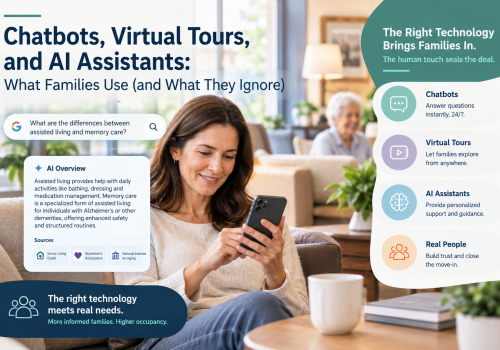
3. Chatbots & Live Chat: Capturing the “After-Hours” Searcher
Senior living research often happens outside of standard business hours—usually between 7 PM and 10 PM, after the adult daughter has put her own kids to bed. If she has a question at 9 PM and your office is closed, she won’t call.
The Tour-Driven Approach:
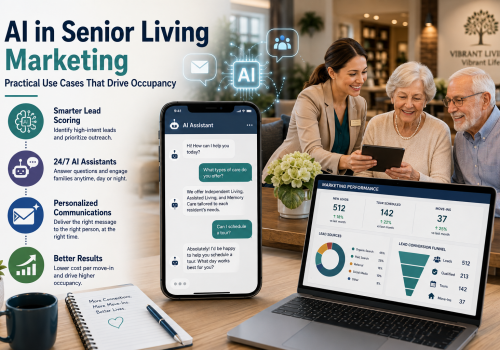
- Speed to Lead: A managed live chat or an intelligent AI chatbot can engage that visitor instantly, answering basic questions and capturing their contact info for your sales team to follow up the next morning.
- Empathy Scripts: Ensure your chat scripts are programmed with empathy (“I understand you are looking for care for a loved one…”) rather than cold, robotic responses.
Technical Considerations for Management Companies
For single-site operators, a website is a standalone project. But for management companies overseeing a portfolio of communities, your web strategy must be scalable. Assisted living web design at the corporate level requires a robust infrastructure that allows you to grow without technical debt.
1. Scalability: The “Cookie Cutter” That Doesn’t Look Like One
When you acquire a new community, you need to get its digital presence up and running immediately to start driving leads. You cannot afford a 6-month design process for every new building.
The Management Strategy:
- Design Systems: Instead of building unique sites from scratch, we build a flexible “Master Theme.” This allows you to deploy a new location page or microsite in weeks, not months. The branding (colors, logos) changes, but the high-converting wireframe remains consistent.
2. CMS Selection: Ownership vs. Leasing
Management companies may feel trapped in proprietary website platforms provided by niche agencies. When they try to leave, they realize they don’t own their code or their content.
The Management Strategy:
- WordPress is King: We recommend WordPress for 99% of senior living projects. It is open-source, meaning you own your website 100%. If you change agencies, you take your site with you. It is also infinitely customizable and supported by a massive global community of developers.
3. Analytics & CRM Integration: Closing the Loop
A “Tour-Driven” website is useless if the leads fall into a black hole. The hand-off between the digital user and the physical sales team must be automated and instant.
The Management Strategy:
- Direct CRM Integration: Your website forms must “talk” directly to your CRM (whether you use Hubspot, Salesforce, or any other CRM). When a daughter fills out a form at 10 PM, that lead should populate in your CRM immediately, triggering an automated email nurture sequence.
- Attribution Tracking: You need to know where the lead came from. Was it Organic Search? A Google Ad? A Facebook post? Implementing proper tracking pixels ensures you know exactly which marketing dollars are generating the best ROI.
Red Flags: When to Redesign Your Community Website
How do you know if your current website is actually hurting your occupancy rates? Sometimes the signs are obvious (broken images), but often they are subtle performance issues that drain your marketing budget silently.
If you recognize any of the following red flags in your current assisted living web design, it is time to consider a rebuild.
1. The Visual Audit: What the User Sees
Open your website on your phone right now. Look at it through the eyes of an exhausted adult daughter.
- The “Pinch and Zoom” Struggle: If you have to pinch your screen to read the text or hit a button, your site is not mobile-responsive. Google penalizes these sites, and users abandon them.
- The “Ghost Town” Copyright: Scroll to the very bottom footer. Does it say © 2019? An outdated copyright date signals to families that the details—and perhaps the care—are not being attended to.
- The “Walled Garden” Navigation: Is your “Schedule a Tour” button buried under a “Contact” tab? If a user has to click more than once to find your phone number or booking form, you are losing leads.
2. The Performance Audit: What the Data Says
Log into your Google Analytics. The numbers don’t lie.
- High Bounce Rate: If your bounce rate is over 70% on your homepage, it means people are landing there and immediately leaving without clicking anything. This usually indicates bad design, slow load speeds, or confusing messaging.
- Zero Organic Inquiries: If all your web leads are coming from paid ads (Google Ads) or referral partners (A Place for Mom), but none are coming from organic search, your SEO foundation is broken. You are effectively renting your traffic rather than owning it.
- Low Time-on-Page: If users are spending less than 45 seconds on your site, your content isn’t engaging them. They aren’t watching your videos or reading your care descriptions.
Conclusion
In the competitive world of senior living, your website is likely the most hardworking member of your sales team. It works 24/7, greets every prospective family, answers their most pressing questions, and—if designed correctly—guides them to your front door.
But as we have explored in this guide, effective assisted living web design is not about winning art awards. It is about winning trust.
From the technical speed required for mobile users to the empathetic photography that comforts an anxious adult daughter, every pixel serves a purpose. A “Tour-Driven” website acknowledges that while the decision to move a parent into care is emotional, the path to getting there is digital.
If your current website is acting as a static brochure rather than a dynamic conversion engine, you are leaving occupancy on the table. You don’t just need a web designer; you need a partner who understands the unique nuances of the senior living buyer’s journey.
Ready to Turn Your Website Into Your Top Salesperson?
Managing a community is difficult enough without worrying if your digital front door is stuck. Let us handle the technology so you can focus on the care.
Schedule a FREE Discovery Call with DIGITAL& today.
We will review your current site’s speed, mobile responsiveness, and conversion funnel to show you exactly where you might be losing leads—and how to fix it.
FAQ
What are the most important features of an assisted living website?
According to the guide, a high-performing senior living website rests on three core pillars: speed and mobile responsiveness, authentic trust signals (real photography and reviews), and ADA compliance. Additionally, the homepage should act as a funnel with clear value propositions and self-selection tools, rather than just serving as a static history of the company.
How can senior living communities increase tour bookings online?
To increase bookings, websites must focus on Conversion Rate Optimization (CRO). This includes using specific, action-oriented Call-to-Actions (CTAs) like “Book a Virtual Visit” instead of generic buttons. It also requires reducing “friction” by keeping contact forms short (sticking to name, phone, and email) and utilizing chatbots to capture leads searching after standard business hours.
Why is local SEO critical for senior care marketing?
Local SEO ensures a community appears when families search for care in a specific geographic radius. Unlike general SEO, this strategy targets high-intent traffic through Google Business Profile integration and dedicated location pages. This is vital for capturing voice searches, such as “memory care near me,” which rely on verified physical locations and specific geographic text modifiers.
How does website design impact trust in senior care facilities?
In this industry, a website is a reflection of care standards. Elements like broken links, slow load times, or outdated copyright dates lead families to subconsciously assume that facility maintenance and medication management are equally neglected. Conversely, a site with high accessibility, real photos, and recent reviews acts as a calming guide that builds immediate trust.
What is the “3-Second Rule” regarding website speed?
The “3-Second Rule” refers to the maximum time a website should take to load before a user abandons it. This is critical because the 50+ demographic has evolved into mobile-first users who often research care during high-stress moments (e.g., in a hospital waiting room). If the site is slow, users will hit the “back” button and likely click on a competitor’s ad.