The Silver Tsunami is no longer a future prediction; it is the current reality. By 2030, all Baby Boomers will be older than 65, expanding the potential customer base for senior living like never before. However, demographics alone do not guarantee occupancy.
While the demand is rising, so is the complexity of the market. The days of simply opening your doors, putting a sign on the lawn, and waiting for the waitlist to fill up are effectively over. We are seeing a shift in consumer behavior where families research longer, expect higher transparency, and trust digital signals over traditional advertising.
For Management Companies and Community Directors, the challenge has evolved. It is no longer just about filling a bed; it is about building a sustainable brand that can weather staffing shortages, economic fluctuations, and intense local competition. The question is: How do you fill a single building with the right residents, and—crucially—how do you scale that success across a growing portfolio without losing the personal touch?
The answer lies in a modern, integrated approach to senior living marketing. Success today requires aligning sales and marketing data to drive actual move-ins, not just raw leads. This guide serves as a roadmap for sustainable growth, designed for leaders managing everything from standalone boutique communities to multi-state portfolios.
The Changing Landscape of Senior Living Marketing
Historically, this industry relied heavily on professional referrals and “drive-by” visibility. While these channels still have value, they are declining in efficiency. If you are noticing your cost-per-lead (CPL) creeping up while conversion rates stagnate, it is likely because your strategy hasn’t pivoted to match the modern buyer.
The Digital Shift is Permanent
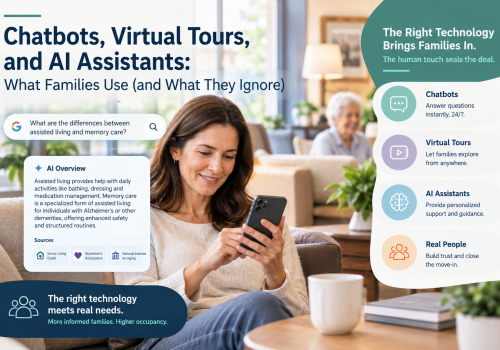
The modern customer journey begins online, often months before a phone call is ever made. It’s very likely that families begin their search for senior care on a search engine. They are comparing amenities, reading policies, and checking star ratings. If your community doesn’t appear prominently on the first page of Google, you are invisible to the highest-intent buyers in your market.
The “Adult Child” vs. “The Resident”
One of the unique complexities of senior living marketing is the dual audience. You are rarely selling to just one person.
- The Resident: Often looking for lifestyle preservation, dining quality, socialization, and independence.
- The Adult Child (The Decision Maker): Usually the daughter, aged 45–65. She is motivated by safety, care levels, proximity to her home, and financial feasibility.
Your marketing narrative must speak to both simultaneously. Search intent varies wildly here; a resident might search for “luxury retirement living with a pool,” while their daughter is panic-searching “nursing home near me” after a fall. A sophisticated strategy recognizes this split and delivers tailored content to each persona.
The Speed of Information
Reputation is everything, but the mechanism of reputation has changed. In the past, trust was built over years of word-of-mouth. Today, a reputation is built (or destroyed) in seconds on Google Reviews or social media. A study done by BrightLocal shows that consumers trust online reviews as much as personal recommendations. Families will vet your community’s digital reputation before they ever schedule a tour. If your digital footprint doesn’t match your physical reality, you lose the lead before you even know they existed.
Building a Scalable Foundation
Before pouring budget into advertising, you must ensure your digital foundation is solid enough to convert the traffic you generate.
Website User Experience (UX)
Your website is your best salesperson—it works 24/7, never takes a holiday, and handles thousands of visitors at once. However, many senior living websites are clunky, slow, or difficult to navigate. This is where professional web design and development becomes a critical asset.
- Mobile Optimization: The adult daughter is likely researching on her phone during her lunch break or in a hospital waiting room. Your site must be fast and mobile-perfect.
- ADA Compliance: Ensuring your site is accessible (readable fonts, high contrast, screen-reader friendly) isn’t just a legal requirement; it’s a necessity for serving an older demographic and their families effectively.
- Frictionless Touring: The ultimate goal of your site is to get a family into the building. Calls to action like “Schedule a Tour” must be sticky, obvious, and require as few clicks as possible to complete.
Brand Architecture
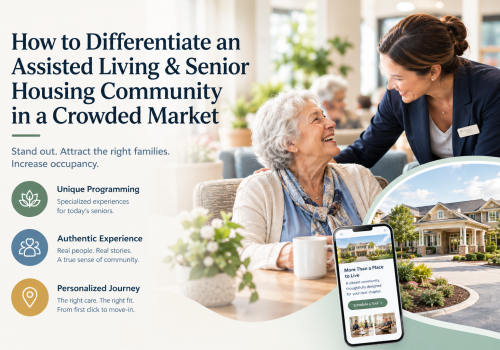
For Management Companies, there is a delicate balance to strike between corporate authority and local charm. You want the “Parent Brand” to convey stability, financial backing, and clinical excellence. However, senior living is intensely local.
The “Local Community” brand must shine through with its own personality, highlighting local staff, regional cuisine, and unique culture. A standardized corporate website often fails to capture the warmth that actually sells the move-in. The best digital strategies allow for this flexibility, ensuring that while the backend technology is centralized, the frontend experience feels deeply personal to the local market.
Core Pillars of a High-Occupancy Strategy
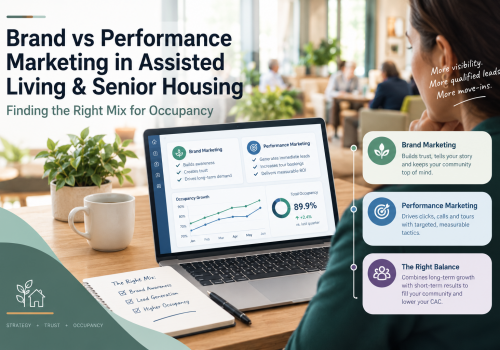
To drive consistent census growth, your senior living marketing strategy must rest on three integrated pillars.
1. Search Engine Optimization (SEO)
You cannot pay for every lead forever; you need a consistent flow of organic traffic to lower your average cost per move-in. This is where a dedicated SEO strategy pays dividends.
- Local SEO: This is the battle for the “Map Pack” (the map listing that appears at the top of Google). You need a verified, optimized Google Business Profile for every single community location, complete with fresh photos, accurate hours, and active Q&A sections.
- Content Strategy: Your blog and service pages need to answer the hard questions families are too afraid to ask initially. Content regarding “Costs of Memory Care,” “How to talk to Dad about moving,” and “Care Level differences” builds immense trust and positions your brand as an educational resource rather than just a sales pitch.
2. Paid Advertising
While SEO builds long-term equity, sometimes you need immediate lead volume to fill vacancies.
- Google Ads (High Intent): These capture the “crisis” shoppers—people searching for immediate availability or specific care needs. Expertly managed paid media campaigns ensure you are bidding on high-intent keywords while using negative keywords to avoid wasting budget on job seekers or irrelevant searches.
- Social Ads (Facebook/Instagram): This is for brand awareness and nurturing. By using lookalike audiences (targeting people who look like your current residents’ families), you can plant the seed of your brand months before the need arises.
3. Reputation Management
You must operationalize your reputation. Don’t hope for reviews; create systems to generate them. This involves training staff to identify happy moments and using software to request feedback automatically. Furthermore, responding to every review is non-negotiable. A thoughtful, HIPAA-compliant response to a negative review shows prospective families that management is responsive, transparent, and cares about resident satisfaction.
Portfolio Power: Marketing for Management Companies
If you oversee a portfolio, your marketing challenges are different. You need economies of scale without sacrificing local relevance.
Centralization vs. Localization
The most successful management companies centralize the data and strategy but localize the content and execution.
- Centralize: Budgeting, reporting, tech stack, and brand guidelines.
- Localize: Social media photos, community event calendars, and blog topics relevant to the specific city.
Economies of Scale
You should be using a unified Customer relationship management (CRM) and platform across the portfolio. This allows you to see global trends. If one region is suffering from low inquiry volume while another is booming, centralized data allows you to diagnose if it’s a market problem or a marketing problem.
Benchmarking
Don’t just look at occupancy; look at marketing performance. Benchmark your communities against each other. If Community A has a 10% inquiry-to-tour conversion rate and Community B has 25%, you have a clear training opportunity.
The Bridge Between Marketing and Sales
Marketing generates the lead; Sales gets the move-in. The hand-off between these two functions must be seamless to avoid “lead leakage.”
Speed to Lead
In senior living marketing, speed is the currency of success. Harvard Business Review data indicates that responding to a lead within an hour increases the likelihood of a meaningful conversation by seven times. If your leads are sitting in an inbox for 24 hours, you are effectively burning marketing dollars.
Lead Nurturing (The “Not Yet” Leads)
Only a small percentage of inquiries are ready to move in immediately. The rest are researching for the future (3–12 months out). If your sales team ignores these “cold” leads, you are losing future occupancy.
- The Strategy: Implement marketing automation workflows. These drip campaigns can automatically send helpful guides, invitations to lunch, and educational articles to prospects over time.
- The Result: You stay top-of-mind so that when the health crisis eventually happens, you are the first call they make, without your sales team having to manually follow up every week.
CRM Hygiene
Marketing data is useless if it doesn’t help the Sales Director. Ensure your marketing forms pass critical data to the CRM—not just a name, but “Care Level Interest,” “Timeframe,” and “Referral Source.” This context allows the sales team to prioritize their outreach and have more empathetic, informed first conversations.
Measuring What Matters (KPIs & ROI)
To truly optimize your growth, you must move beyond “vanity metrics” like Facebook Likes or Website Hits. You need to track metrics by setting up powerful analytics tracking that impact Net Operating Income (NOI).
- Cost Per Lead (CPL) vs. Cost Per Move-In (CPMI): A cheap lead is worthless if they never move in. CPMI is the true measure of marketing efficiency.
- Inquiry-to-Tour Ratio: Are your leads qualified? If this is low, marketing needs to adjust targeting.
- Tour-to-Deposit Ratio: Is your sales team performing? If this is low, sales training may be required.
- Length of Stay (Lifetime Value): Sometimes the “hardest” leads to get (higher acuity) stay the longest, justifying a higher marketing spend.
Conclusion
The senior living industry is evolving rapidly. The communities that win in the next decade will be those that treat senior living marketing not as a simple expense line item, but as a strategic engine for portfolio growth. By integrating digital excellence, robust reputation management, and tight sales alignment, you can build a predictable pipeline of happy families and healthy occupancy rates.
Is your community or portfolio ready to scale?
Don’t let your leads slip through the cracks. At DIGITAL&, we specialize in helping senior living communities and management companies navigate this digital transformation. If you are ready to audit your current strategy and discover how to drive sustainable growth, contact us today.
FAQ
What are the most effective digital marketing channels for senior living?
To drive consistent census growth, a strategy must rely on three integrated pillars: Search Engine Optimization (SEO) to lower the average cost per move-in over time, Paid Advertising (Google and Social Ads) for immediate lead volume and brand awareness, and Reputation Management to build necessary trust with families.
How important is a mobile-friendly website for senior care communities?
It is critical. The primary decision-maker (often an adult daughter) is likely researching on her phone during breaks or in waiting rooms. Consequently, websites must be fast, mobile-perfect, and ADA compliant to serve both the older demographic and their families effectively.
How can senior living communities improve their lead conversion rates?
Improving conversion requires aligning marketing and sales to prevent “lead leakage.” This includes increasing “speed to lead” (responding within an hour), using marketing automation to nurture “cold” leads who aren’t ready to move in for months, and ensuring the CRM receives detailed data (care level, timeframe) to help sales teams prioritize outreach.
What metrics should be tracked to measure senior living marketing success?
Avoid focusing solely on vanity metrics like Facebook likes. Instead, track metrics that impact Net Operating Income (NOI), specifically Cost Per Move-In (CPMI), Inquiry-to-Tour Ratio, Tour-to-Deposit Ratio, and the lifetime value of the resident based on their length of stay.
How should management companies handle marketing for multiple locations?
The most successful approach is to centralize backend operations—such as budgeting, reporting, and the tech stack—to gain economies of scale. However, the frontend experience must be localized, with specific social media content, photos, and blogs that highlight the unique personality and culture of each individual community.