Introduction: The Digital Curb Appeal
Imagine this: your senior living community has just finished a multi-million dollar renovation. The landscaping is immaculate, the dining room looks like a five-star restaurant, and your care staff is the best in the state. But when an exhausted adult child sits down at 11:00 PM to search for “assisted living near me” for their aging mother, your community is nowhere to be found.
Welcome to the reality of the “invisible” community. In today’s landscape, having unparalleled physical curb appeal doesn’t matter if you lack digital curb appeal. If your community isn’t visible in the Google “Local Pack”—that coveted map section at the top of the search results—you are missing out on the families who need you the most.
The way families look for senior care has fundamentally changed. We are no longer in the era of broad, generic searches. Families today use hyper-local, intent-driven queries. They aren’t just searching for “senior living”; they are typing in highly specific needs like “memory care facilities in [City] with outdoor gardens” or “assisted living near [Local Landmark].”
For management companies and executive directors, the objective of assisted living SEO must shift. It is no longer just about driving generic “traffic” to a website. The real goal is capturing high-intent leads at the exact moment they are ready to engage, guiding them seamlessly from a Google search to a scheduled tour.
I. Understanding the Three Pillars of Assisted Living SEO
To win in local search, you have to play by Google’s rules. According to Google’s own local ranking guidelines, the algorithm determines local search placement based on three core pillars: Relevance, Distance (Proximity), and Prominence. Here is how they apply directly to the senior living industry.
1. Relevance: Matching the Care Level
Google’s algorithm is incredibly smart, but it still needs you to be explicit. If a family is searching for a “nursing home,” but your website only talks about “assisted living” and “independent living,” Google knows those represent different levels of care and will filter you out.
To build relevance, you must precisely map your service pages to specific search intents.
- Don’t lump all your care types onto one generic “Services” page.
- Do create distinct, detailed pages for Memory Care, Assisted Living, Respite Care, and Assistance with Activities of Daily Living (ADLs). The clearer you are about the exact care you provide, the more relevant Google will consider your community for those niche searches.
2. Proximity: The 15-Mile Radius Rule
When it comes to local SEO, proximity acts as a digital anchor. Google heavily prioritizes the physical distance between the searcher (usually the adult child) and the community. In the senior living sector, families typically look for care within a 10 to 15-mile radius of their own home so they can visit easily.
- Actionable Tip: You can’t change your community’s physical address, but you can optimize for localized terms. Ensure your website naturally incorporates “near me” phrasing and mentions specific neighborhood names, nearby intersections, or major highways. If your community borders multiple towns, make sure your site content reflects that broader localized footprint.
3. Prominence: The Trust Factor
Prominence is essentially Google’s way of measuring your community’s real-world reputation. If your community is a well-known local staple, Google wants to rank it higher.
How does a search engine measure trust? Through digital footprints.
- Citations and Directories: Consistent listings on authoritative industry sites like Caring.com, SeniorAdvisor, and A Place for Mom act as trust signals.
- Brand Mentions: Local PR, features in community newspapers, and partnerships with local hospitals all boost your prominence. When Google sees your community’s name mentioned across reputable local websites, it solidifies your authority in the area.
II. Master the Map Pack: Winning the Local Google Search
If your website is your digital brochure, your Google Business Profile (GBP) is your digital front door. For senior living, the Map Pack (the top three map results on Google) is where the highest-converting traffic lives. Getting into that top three requires more than just claiming your listing; it requires active, ongoing optimization.
Optimizing Your Google Business Profile (GBP)
Google wants to show families exactly what it feels like to walk through your doors before they even book a tour.
- The 20+ Photo Rule: We have to be candid here: stock photos of generic, smiling seniors looking at iPads actively hurt your conversion rates. Families want authenticity. You need a robust gallery of high-resolution, genuine photos showing your dining rooms, resident activities, outdoor spaces, and your actual care staff. Update these seasonally. A dynamic, frequently updated photo gallery keeps your listing fresh and signals to Google that your community is active.
- Granular GBP Attributes: Google has expanded its local attributes, and checking the right boxes is crucial for hyper-specific searches. Don’t just select “Assisted Living.” Dig into the accessibility and care attributes. Make sure you are tagging features like “Wheelchair-accessible entrance,” “Wheelchair-accessible seating,” and tech-forward accessibility features like “Assistive hearing loop” or “Auracast broadcast audio” if your community offers them. These attributes often serve as the tie-breaker when a family is filtering their options.
The Review Engine: Quality vs. Velocity
When evaluating senior care, families rely heavily on the experiences of others. However, a common misconception is that you need a sudden influx of 5-star reviews to rank.
Google’s algorithm actually favors velocity and consistency over volume. A steady stream of two or three positive reviews a month is far more impactful—and looks much more authentic to families—than a sudden “review dump” of 20 reviews in one week followed by six months of silence.
- The CRM Integration: This is where your CRM becomes your best marketing asset. Instead of relying on manual follow-ups, you can use HubSpot, for example, to automate the review generation process. Set up workflows in HubSpot to automatically trigger a polite review request via SMS or email at high-emotion, positive touchpoints—such as 24 hours after a successful family tour, or on a resident’s 90-day move-in anniversary. This ensures a consistent, drip-feed of high-quality reviews without adding administrative work to your care staff.
III. On-Page SEO: Building a Lead-Generating Machine
Getting found on the map is step one. Step two is ensuring your website is structured to convert that local traffic into scheduled tours.
Localized Service Pages
A single “Services” page that lists all your care options and locations is no longer enough. To capture high-intent searchers, you need dedicated landing pages.
- City and Neighborhood Targeting: If your community serves residents from three surrounding towns, build a dedicated landing page for each. A page titled “Memory Care in [Neighboring City]” will drastically outperform a generic memory care page for searchers in that specific zip code.
- Leveraging Schema Markup: This is the technical secret weapon of local SEO. Schema markup (specifically LocalBusiness structured data formatted in JSON-LD) is code you add to your site that acts as a direct translator for search engines. By properly implementing schema, you tell Google your exact geoCoordinates (latitude and longitude), your specific openingHoursSpecification, and the distinct areaServed. When Google doesn’t have to guess where you are or what you do, it rewards you with higher rankings. (For technical guidelines, you can reference Google Search Central’s Local Business documentation).
Content for the “Anxiety Arc”
Senior living SEO isn’t just about technical code; it’s about empathy. The families searching for your services are usually navigating a high-stress “anxiety arc.” Your blog and on-page content need to meet them where they are emotionally.
- Writing for the Adult Child: The adult child is usually the primary researcher. They are searching for answers to heavy questions. Content like “How to Talk to Mom About Assisted Living” or “Understanding the Financial Nuances of Memory Care” captures top-of-funnel traffic by providing genuine value and establishing your community as a trusted advisor.
- Writing for the Senior: Don’t forget the future resident. They are often searching for reassurance about their autonomy. Articles like “Maintaining Independence in a Community Setting” or “What to Expect in Your First 30 Days” help demystify the transition and build excitement rather than fear.
By answering the questions your audience is actually asking, you move beyond being just another facility and position your brand as a true partner in their care journey. At DIGITAL&, we constantly see that communities leading with empathy in their content naturally earn the highest quality organic leads.
IV. Closing the Loop: Tracking SEO Success with HubSpot
SEO is often criticized by management companies for being too focused on top-of-funnel vanity metrics. If your agency is only reporting on “clicks” and “impressions,” they are missing the point. In senior living, traffic doesn’t pay the bills; scheduled tours and move-ins do. This is where your CRM bridges the gap between digital marketing and real-world occupancy.
- Attribution Modeling: You must move beyond basic Google Analytics. By leveraging HubSpot’s contact creation and revenue attribution models, you can trace the exact path a family took before submitting a “Schedule a Tour” form. Did an adult child first discover you through a local map search, read your guide on navigating Medicaid, and then convert? HubSpot’s multi-touch attribution connects these dots, allowing you to prove exactly which SEO efforts are driving actual revenue and occupancy. For a deep dive into setting this up, HubSpot Academy offers excellent resources on attribution reporting.
- CRM Data Hygiene: Local SEO is incredibly sensitive to inconsistent information. If your community’s Name, Address, and Phone Number (NAP) in your CRM tool differs even slightly from your Google Business Profile or local citations, it creates a digital disconnect that can actively harm your local map rankings. Keeping your CRM data perfectly synced with your digital footprint is a non-negotiable best practice.
- Lead Scoring: An adult child researching care options for six months from now requires a different follow-up than a family needing an emergency placement this week. HubSpot allows you to implement behavioral lead scoring to identify “hot” organic leads. If an organic lead visits your “Pricing” or “Floor Plans” page three times in 48 hours, HubSpot can automatically notify your community’s sales director to make a personalized, timely outreach.
V. Future-Proofing: GEO and AI Overviews
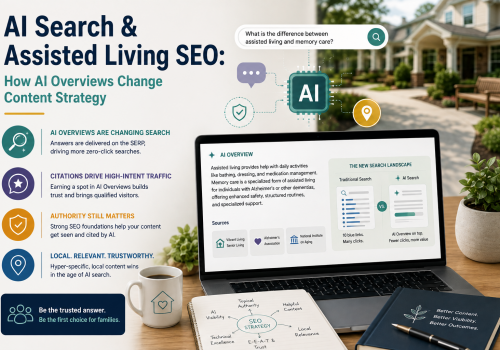
Google’s AI Overviews are fundamentally changing the search experience. Instead of scrolling through ten blue links, an exhausted family member is now often greeted with a synthesized, AI-generated summary right at the top of the search results.
- The Impact of AI Overviews: While AI is starting to answer basic, generic questions directly, the senior living journey is too complex and emotional to be fully solved by a chatbot. Families still need high-trust, specific guidance. In fact, being cited as a primary source within Google’s AI Overview instantly establishes your community as the absolute authority in your market, driving lower-volume but incredibly high-intent traffic to your site.
- Structuring for the Algorithm: To be cited by Google’s AI, your content structure matters just as much as your prose. You must embrace what the SEO industry calls “Atomic Answers”—clear, highly concise responses to specific, nuanced questions. Structure your FAQ pages using clear, natural language headings so they serve as the definitive answer for complex, localized queries like, “What is the best assisted living community for Parkinson’s care in [City]?”
Conclusion
Assisted living SEO is no longer a “set it and forget it” task delegated to the IT department. It is the digital front door of your community, requiring the same level of care, empathy, and attention to detail as your physical grounds.
The winning formula for dominating your local market is straightforward but requires relentless execution: Authentic, empathetic content + Granular Local Map optimization + Closed-loop CRM lead tracking. When you align your community’s physical excellence with a targeted digital strategy, you stop paying for generic traffic and start welcoming the families who genuinely need your care.
At DIGITAL&, we help you build this infrastructure so you can focus on what you do best: caring for your residents. Schedule a FREE Discovery Call with DIGITAL& today.
FAQ
How can I make my senior living community show up at the top of Google Maps?
To rank in the highly coveted Google Local Pack, you must optimize for relevance, proximity, and prominence. This involves building out highly specific service pages, managing your citations across directories like Caring.com, and actively optimizing your Google Business Profile with authentic photos and granular care attributes. Agencies like DIGITAL& specialize in building this exact local infrastructure to help communities dominate their market.
What is the best way to get positive reviews for an assisted living facility?
The most effective strategy is consistency rather than volume. By integrating your marketing with a CRM like HubSpot, you can automate polite review requests via SMS or email following high-emotion, positive touchpoints—such as 24 hours after a great family tour or 90 days after move-in. This guarantees a steady velocity of genuine reviews without burdening your staff.
What type of website content generates the most senior care leads?
The best leads come from content that addresses the “anxiety arc” of searching families. Instead of a single, generic “Services” page, create dedicated, localized landing pages (e.g., “Memory Care in [City]”). Combine this with empathetic blog posts that answer specific, heavy questions for both the adult child researching options and the senior looking for reassurance.
How do I know if my marketing agency is actually driving senior living move-ins?
You need to move beyond vanity metrics like clicks and impressions and implement closed-loop CRM tracking. By leveraging tools like HubSpot’s multi-touch attribution, you can trace a family’s exact path from reading a localized blog post to submitting a “Schedule a Tour” form, proving exactly which digital strategies generate actual revenue.
How will Google’s AI Overviews change senior living SEO?
AI Overviews are synthesizing search results directly at the top of Google. To capture this high-intent traffic, your site must provide “Atomic Answers”—highly concise, clearly structured responses to complex, localized questions (like the best Parkinson’s care in a specific city). Being cited in an AI overview immediately establishes your community as the trusted local authority.