Introduction: The Shift from “Search” to “Solution”
Empty beds cost more than just revenue; they represent a failure to connect a family in crisis with the solution they need.
For years, the senior living industry treated Search Engine Optimization (SEO) as a volume game—a race to rank for broad terms like “retirement home.” But in 2026, the landscape has shifted. With occupancy rates stabilizing around 88% according to NIC data, the fight is no longer just for traffic; it is for trust.
Families searching today are more informed and more stressed than ever. They aren’t just looking for a facility; they are looking for a partner in care. When an adult daughter sits in a hospital waiting room at 2:00 AM searching for “memory care near me,” she isn’t browsing. She is hunting for an answer.
If your community doesn’t appear in that moment—with clear answers, transparent pricing, and strong social proof—you haven’t just lost a click. You’ve lost a move-in.
The “Why” for Your Organization
We need to look at SEO through two different lenses:
- For Management Companies (The ROI – Return on Investment – Lens): Paid ads (PPC) are renting attention; SEO is owning real estate. While PPC costs rise every year, a strong organic presence drives down your Cost Per Lead (CPL) over time, delivering a compounded return on investment that scales across your entire portfolio.
- For Communities (The Occupancy Lens): SEO is your digital curb appeal. It ensures that you are the first helpful hand a local family sees. It bridges the gap between their anxiety and your solution.
This guide moves beyond basic keywords. We will cover the end-to-end ecosystem of ranking your community—from technical health and “Map Pack” dominance to the content strategies that turn searchers into residents.
Why “Local” is the Lifeblood of Senior Living SEO
There is a massive difference between “National SEO” and “Local SEO,” and mistaking one for the other is the most common reason communities fail to rank.
The “Near Me” Reality
Queries containing “near me” or “close to me” have exploded in recent years, signaling high intent. In senior living, this intent is virtually 100%. A family in Dallas is not interested in a 5-star community in Houston.
Google understands this. If you search for “Assisted Living,” Google’s algorithm immediately triggers a Local Pack—that map at the top of the search results showing three businesses. It is important that your business is a part of this list.
National Brand vs. Hyper-Local Entity
This presents a unique challenge for Management Companies. You have a corporate brand to protect, but Google treats every single one of your physical communities as a unique, standalone entity.
- The Mistake: Relying on a strong corporate domain (managementco.com) to carry the weight for a local property (managementco.com/locations/sunny-pines).
- The Fix: You must treat every community page as if it were a standalone local business website. This means unique content, unique local citations, and a unique Google Business Profile for every single door you open.
The “Map Pack” Gold Rush
Data from Local Dominator suggests that the “Local Pack” (the top 3 map results) captures the majority of clicks. Why? Because it offers immediate utility:
- Proximity: “Is it close to Mom’s current home?”
- Social Proof: “Does it have 4+ stars?”
- Access: “Can I click-to-call right now?”
If your community is ranking #1 organically (in the text results) but is invisible in the Map Pack, you are likely missing out on some of your potential inquiries.
The 4 Pillars of a High-Occupancy SEO Strategy
You cannot “trick” Google into ranking a senior living community in 2026. The algorithm is too smart. Instead, you must prove to Google that you are the most relevant, trustworthy, and accessible answer in your specific geofence.
We build this proof through four distinct pillars.
Pillar 1: Technical Health (Building on Solid Ground)
Before we write a single word of content, we must ensure the “digital building” is up to code. If your site is slow or confusing, Google will not refer families to you, just as a referral agency wouldn’t send a family to a community with a leaky roof.
- Speed is a Trust Signal: Senior living searches might happen in high-stress environments—hospitals, rehab centers, or family living rooms. If your site takes more than 2.5 seconds to load, visitors might bounce. Google’s Core Web Vitals are now a direct ranking factor. A fast site says, “We are professional and ready to help.”
- Site Architecture & Hierarchy: Google needs to understand the relationship between your care levels. A flat site structure confuses the crawler.
- Bad Structure: domain.com/services (listing everything in one blob).
- Good Structure: domain.com/care-options/assisted-living/ and domain.com/care-options/memory-care/. This allows you to rank specifically for “Memory Care” without diluting your “Assisted Living” relevance.
- Schema Markup (The Secret Weapon): Schema is code that speaks directly to search engines. For senior living, standard “Business” schema isn’t enough. You should be using specific schema types such as:
- Schema.org/RetirementCommunity for Independent Living.
- Schema.org/NursingHome or MedicalBusiness for higher acuity care.
- Pro Tip: Use “HasMap” schema to explicitly link your page to your Google Maps location.
Pillar 2: Google Business Profile (Your Digital Front Door)
Your website might be your house, but your Google Business Profile (GBP) is your front porch. For many families, this is the only thing they look at before calling.
- Claiming & Verification: This sounds basic, yet some senior living profiles remain unclaimed or unverified, leaving them vulnerable to edits by competitors or disgruntled former staff.
- The “Category” Trap: Choosing the wrong primary category is the #1 reason communities fail to rank in the Map Pack.
- Independent Living could use “Retirement Community”.
- Assisted Living could use “Assisted Living Facility”.
- Skilled Nursing could use “Nursing Home”.
- Warning: Do not stuff every category into your profile. If you are primarily Assisted Living, do not list yourself as a “Senior Center” (which implies a recreational community center). Confusing Google dilutes your ranking power.
- Reviews as Ranking Fuel: Review velocity (how often you get new reviews) and keyword-rich reviews matter. A review that says “The memory care staff at [Community Name] is amazing” is infinitely more powerful for SEO than a review that just says “Great place.”
Pillar 3: Content Strategy (Answering the “Crisis Questions”)
Content in senior living falls into two buckets: Educational (Top of Funnel) and Transactional (Bottom of Funnel). You need both. You can learn more on marketing funnel and its stages here.
- Top-of-Funnel (The “Guide”): These searchers are just realizing they have a problem. They are asking, “Signs of dementia in aging parents” or “Difference between assisted living and nursing home.”
- The Goal: Build trust. If you answer their early questions, they will remember you when they are ready to tour.
- Bottom-of-Funnel (The “Closer”): These searchers are ready to move. They are searching for “Cost of memory care in [City]” or *”Pet-friendly assisted living [City].”
- The Goal: Conversion. These pages should have clear “Schedule a Tour” buttons and pricing transparency.
- E-E-A-T (Experience, Expertise, Authoritativeness, Trust): Senior living is a “Your Money Your Life” (YMYL) industry. Google holds your content to a higher standard. Ensure your health-related blog posts are reviewed by your Medical Director or Director of Nursing, and clearly list their credentials on the page.
Pillar 4: Reputation & Citations (The Trust Web)
Google checks its work. If your website says you are located at 123 Oak Street, but a directory like Yelp says 123 Oak St, Suite B, and Facebook says 125 Oak Street, Google loses trust in your data.
- NAP Consistency: Your Name, Address, and Phone number must be identical across the web. This includes major aggregators like Caring.com, A Place for Mom, SeniorAdvisor, and general directories like Bing Places and Apple Maps.
- The Aggregator Strategy: You cannot out-spend A Place for Mom on national keywords. But you can beat them on local authenticity. They have stock photos; you have photos of your actual Chef, Maria. They have generic text; you have the specific menu for next Tuesday. Use that local detail to win the “Near Me” search.
Navigating the “Aggregator Problem” (A Place for Mom, Caring.com)
A common question Management Companies deal with is: “Why are these lead aggregators ranking above us for our own brand name?”
The Challenge
Aggregators have massive domain authority (DA). They have millions of backlinks and thousands of pages. Fighting them head-on for broad terms like “Senior Living” is a losing battle.
The Strategy: Hyper-Local Dominance
Aggregators rely on templates. Their page for “Assisted Living in [City]” is often just a list of facilities with generic intro text.
- Beat them with specificity: Your community page should talk about local landmarks, local partnerships (e.g., “Just two miles from [Local Hospital]”), and specific local events.
- Beat them with media: High-quality, original video tours and 360-degree views keep users on your page longer. Google notices this “dwell time” and rewards it.
- Beat them with “People”: Aggregators are faceless – showcase your Executive Director and key staff. People buy from people.
Measuring Success: KPIs That Matter to the C-Suite
Traffic is vanity; move-ins are sanity. To prove the value of SEO to your investors or owners, you must track the right metrics.
Vanity Metrics vs. Revenue Metrics
Stop reporting on “Impressions.” Start reporting on Intent.
- 1. Organic Goal Completions: How many “Schedule a Tour” forms were filled out by users who came from Google Organic?
- 2. GBP Actions: How many people clicked “Call” or “Get Directions” directly from your Google Map listing? (These are often your hottest leads).
- 3. Local Keyword Growth: Are you ranking in the top 3 for “[City] memory care”?
- 4. Attribution: Use tools like GA4 to see “Assisted Conversions.” Often, a family finds you via SEO, reads three blog posts, leaves, and returns a week later via a direct URL to book a tour. SEO gets the assist, even if it didn’t score the goal.
Future-Proofing: AI, Voice Search, and SGE
If “Local” is the battleground of today, Generative Engine Optimization (GEO) is the battleground of tomorrow.
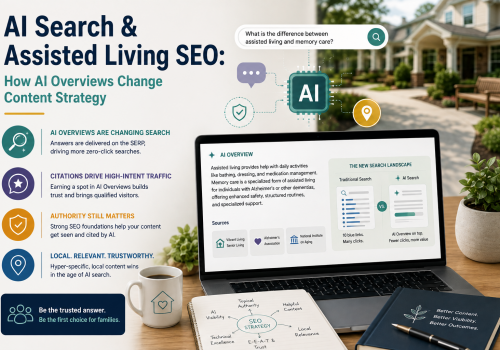
Google has moved beyond the “10 blue links.” With the rise of AI Overviews, ChatGPT, Gemini, and Perplexity, families are searching differently. They aren’t just typing “Assisted living Dallas” anymore. They are asking complex, conversational questions like: “Find me a memory care community in Dallas under $6k/month that allows cats and has a secure courtyard.”
1. Generative Engine Optimization (GEO)
To rank in this new AI-first world, keywords aren’t enough. You need to be the authority that the AI cites.
- The Strategy: Structure your content to answer questions directly. AI models love “Answer Engine” formatting.
- Instead of: A 1,000-word essay on pricing.
- Do this: A clear Q&A section on your site: “What is the cost of care at [Community Name]?” followed by a concise, data-backed answer.
- The Goal: You want the AI to say, “According to [Your Community], the average cost is…” This is the new “Position Zero.”
2. Voice Search & The “Sandwich Generation”
Adult daughters (the primary decision-makers) are often multitasking. They are using Siri or Alexa while driving or cooking.
- Conversational Keywords: Voice searches are longer and more natural. Optimize for phrases like “Who offers respite care near me for the weekend?” rather than just “Respite care.”
- The “Near Me” Trigger: Voice assistants rely almost exclusively on your Google Business Profile (GBP) location data. If your GBP is unverified or lacks hours of operation, Siri will skip you.
3. The “Helpfulness” Hedge
Algorithms change, but human needs do not. The only true hedge against AI updates is to be the most genuinely helpful resource in your market. Google’s recent updates punish “SEO content” written for robots and reward content written for people.
- Action: Audit your blog. Does it sound like a brochure, or does it sound like a compassionate advisor? If you wouldn’t say it to a family in your lobby, delete it from your website.
Conclusion: Owning Your Market
SEO for senior living is not a “set it and forget it” task. It is an operational habit, just like clinical rounds or dining service.
The communities that win in 2026 won’t necessarily be the ones with the biggest marketing budgets. They will be the ones that understand that digital visibility is the first step in care. By fixing your technical foundation, dominating the Local Map Pack, and answering the crisis questions families are asking, you do more than just improve your rankings.
You ensure that when a family is scared, confused, and looking for an answer, your door is the one they find open.
Don’t let your empty beds be a result of invisibility.
Is your community invisible to the families searching right now?
Stop guessing why your phone isn’t ringing. Schedule a FREE Discovery Call with DIGITAL&. We’ll review your Google Business Profile, site speed, and local rankings to uncover exactly where you’re losing leads—and how to get them back.
FAQ
Why isn’t my senior living community ranking on Google Maps?
If your community is invisible in the “Local Pack” (the top 3 map results), it is often due to a lack of “local proof.” The article highlights that ranking requires a verified and optimized Google Business Profile, consistent Name/Address/Phone (NAP) citations across the web, and a steady velocity of keyword-rich reviews. Additionally, if you have chosen the wrong primary category (e.g., using “Senior Center” instead of “Assisted Living Facility”), you may be diluting your ranking power.
How can individual communities outrank lead aggregators like A Place for Mom?
You cannot beat aggregators on Domain Authority, but you can beat them on “Hyper-Local Dominance.” Aggregators rely on generic templates and stock photos. To outrank them, the text suggests filling your site with hyper-local content: mention specific local landmarks (e.g., “two miles from [Local Hospital]”), showcase real videos of your staff, and publish specific weekly menus. Google rewards this unique local data and “dwell time” over generic listings.
How does website speed affect senior living occupancy?
Site speed is a direct trust signal. Families searching for care are often in high-stress environments, such as hospital waiting rooms. The article notes that if your mobile site takes more than 2.5 seconds to load, visitors will likely bounce. A slow site suggests a lack of professionalism, whereas a fast, technically healthy site reassures families that you are ready to help immediately.
What is the best content strategy for increasing senior living tours?
Effective content must address two distinct stages: “Educational” and “Transactional.” Top-of-funnel content should answer early crisis questions (e.g., “signs of dementia”), building trust before a sale is made. Bottom-of-funnel content must be the “closer,” providing transparent pricing, “Schedule a Tour” buttons, and direct answers to specific queries like pet policies. This combination turns searchers into residents.
How do I optimize my senior living website for AI and voice search?
To prepare for AI (Generative Engine Optimization) and voice search, you must structure your content to answer questions directly. Instead of long essays, the guide recommends using clear Q&A formats (e.g., “What is the cost of memory care at [Community]?”) followed by concise, data-backed answers. This increases the likelihood of your content being cited by AI tools and read aloud by voice assistants like Siri, which rely heavily on your Google Business Profile data.