Introduction
Every vacant unit in an assisted living community represents more than an occupancy gap. It means lost revenue, underutilized capacity, and additional pressure on operating margins. Senior housing occupancy, rental rates, and operating performance are closely connected to the industry’s financial outlook. For operators, this makes maintaining a consistent pipeline of qualified inquiries and move-ins essential to long-term profitability.
Yet determining how much an assisted living community should spend on marketing remains a challenge. Many senior housing operators rely on fixed annual budgets, historical spending patterns, or broad percentage-of-revenue guidelines without considering the actual cost of vacant units, local competition, and the number of move-ins needed to achieve occupancy goals. While these approaches may simplify financial planning, they can also limit growth opportunities or lead to inefficient marketing investments.
An effective senior living marketing budget should combine two perspectives: top-down financial benchmarks and bottom-up acquisition planning. By evaluating marketing spending as a percentage of gross revenue alongside cost per inquiry, cost per move-in, and occupancy targets, operators can develop a more defensible budget that connects marketing investments directly to business performance.
This guide explores how Assisted Living, Memory Care, and senior housing communities can calculate their marketing budgets using practical financial models, evaluate acquisition costs, and allocate spending across digital advertising, SEO, community outreach, and CRM automation. The goal is to help operators move beyond arbitrary spending limits and build a measurable marketing strategy that supports sustainable occupancy growth.
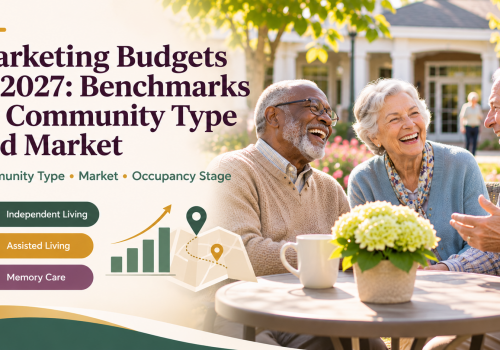
II. Top-Down Benchmarks: How Much Do Senior Living Communities Spend on Marketing?
Understanding senior living marketing spending benchmarks provides a useful starting point for determining an appropriate budget. However, marketing investments vary significantly depending on occupancy levels, community size, care type, and growth objectives. Operators should evaluate industry spending patterns alongside their own financial performance rather than relying on a universal percentage.
Marketing Budget as a Percentage of Gross Revenue
A survey of nonprofit senior living operators conducted by Ziegler found that organizations allocated an average of 4.86% of their operating budgets to marketing in 2022, with single-site operators averaging 4.22% and multi-site organizations averaging 6.3%, according to Senior Housing News. Although these figures are not directly comparable to marketing spending as a percentage of gross revenue, they illustrate how allocations differ across operating structures.
For budgeting purposes, stabilized Assisted Living communities might evaluate a 6%–10% revenue allocation, while lease-up properties may consider higher investments of 12%–20% to accelerate occupancy growth. Memory Care communities may also require additional acquisition spending due to specialized care needs and competitive conditions. These percentages are illustrative planning scenarios, not verified industry medians, and should be adjusted based on property-level financial projections. USR Engage states that “Senior living communities should allocate 7-10% of gross revenue to marketing”.
Annual Marketing Spend Per Unit
Another practical way to evaluate an assisted living marketing budget is to calculate annual spending per available unit. This metric allows operators to compare marketing investments across communities of different sizes and identify whether spending aligns with occupancy objectives.
For example, a 100-unit community allocating $120,000 annually to marketing spends $1,200 per available unit, or $100 per unit per month. A property pursuing aggressive growth might allocate $250,000 annually, equivalent to $2,500 per available unit. These examples are budgeting scenarios rather than established industry averages.
However, per-unit spending should not be evaluated in isolation. According to NIC’s senior housing market research, rental revenue, operating expenses, and market conditions influence property-level financial performance. Communities should therefore compare per-unit marketing costs against expected resident revenue, contribution margins, and actual move-in results.
Ultimately, the most useful senior housing marketing benchmarks combine revenue-based allocations with per-unit spending and acquisition performance. This creates a stronger financial foundation for determining whether marketing investments are sufficient to maintain occupancy, support lease-up goals, and generate sustainable returns.
III. The Bottom-Up Budgeting Model: Calculating Marketing Spend From Move-In Goals
While industry benchmarks provide a useful starting point, the most effective assisted living marketing budget is built around the number of move-ins required to achieve occupancy targets. A bottom-up budgeting model connects marketing spending to measurable outcomes by accounting for resident attrition, lead conversion rates, and customer acquisition costs.
Step 1: Calculate the Number of Move-Ins Needed
Start by identifying your current occupancy, target occupancy, and expected resident move-outs over the planning period. The National Investment Center for Seniors Housing & Care (NIC) publishes senior housing occupancy research that can help operators evaluate their performance against broader market conditions.
For example, consider a 100-unit Assisted Living community operating at 82% occupancy with a goal of reaching 92% within 12 months. Assuming 15 resident move-outs during that period, the community would need 25 gross move-ins to achieve its target.
Required Move-Ins = Target Occupied Units − Current Occupied Units + Expected Move-Outs
In this example: 92 − 82 + 15 = 25 move-ins.
The assumed 15 move-outs are illustrative, not an industry attrition benchmark.
Step 2: Reverse-Engineer Your Lead Conversion Funnel
Once the move-in target is established, operators should use historical conversion rates to determine how many tours, inquiries, and website visitors are needed. Tracking these stages through a platform such as HubSpot CRM allows marketing and sales teams to monitor lead progression and identify opportunities to improve conversion performance.
For illustration, assume a community converts 30% of completed tours into move-ins, 20% of qualified inquiries into completed tours, and 3% of website visitors into qualified inquiries. To generate 25 move-ins, the community would need approximately 84 tours, 420 qualified inquiries, and 14,000 website visits over the year.
These conversion rates are modeling assumptions rather than verified senior living industry averages. Actual targets should be based on the community’s historical performance, care level, and lead sources.
Step 3: Establish Your Target Cost Per Move-In
The final step is determining how much the community can afford to spend acquiring each resident. Cost per move-in (CPMI) is calculated by dividing attributable marketing expenses by the number of marketing-generated move-ins.
For example, if the community establishes a target CPMI of $2,500 and needs 25 marketing-generated move-ins, its projected acquisition budget would be $62,500. This calculation assumes marketing is responsible for all 25 move-ins and excludes additional expenses not included in the CPMI definition.
Operators should also compare direct acquisition costs against third-party referral fees. Rather than assuming that one channel is universally less expensive, evaluate the total acquisition cost, lead quality, and actual move-in conversion rates associated with each source.
By combining occupancy targets, conversion rates, and acquisition costs, senior housing operators can develop a data-driven marketing budget that reflects their specific growth requirements instead of relying solely on arbitrary spending percentages.
IV. Strategic Channel Allocation: Where Should Your Marketing Dollars Go?
An effective assisted living marketing budget should balance immediate lead generation with long-term visibility and prospect nurturing. While stabilized communities may prioritize maintaining occupancy and reducing acquisition costs, lease-up properties typically require greater investments in awareness and high-intent advertising to accelerate move-ins.
The following allocations offer an illustrative framework for distributing senior living marketing spend based on a community’s growth stage. These are recommended planning ranges, not industry-wide averages.
| Marketing Channel | Stabilized Communities | Lease-Up / Growth |
| Google Ads / Paid Search | 30% | 40% |
| Local SEO, Content & Website CRO | 30% | 20% |
| Paid Social & Retargeting | 15% | 20% |
| Email Marketing & CRM Automation | 10% | 5% |
| Community Outreach & Events | 10% | 10% |
| Creative Assets & Collateral | 5% | 5% |
| Total | 100% | 100% |
Prioritizing High-Intent Digital Marketing
Paid search should play a central role in capturing families actively researching senior housing options. Google Ads campaigns targeting searches such as “assisted living near me” or “memory care in [city]” can connect communities with prospective residents closer to making a decision. According to Google Ads documentation, search campaigns allow advertisers to reach users based on relevant search queries, making them particularly useful for demand capture.
Meanwhile, local SEO and conversion rate optimization (CRO) help communities build sustainable organic visibility and convert website traffic into qualified inquiries. As outlined in Google’s SEO Starter Guide, creating helpful content and making websites accessible to search engines are foundational practices for improving search visibility. To learn more about improving local rankings and SEO, you can explore our comprehensive guides on Local SEO for Assisted Living & Senior Housing and Why Senior Housing Websites Don’t Rank (and 12 Fixes).
Balancing Awareness, Lead Nurturing, and Community Engagement
Paid social campaigns can complement search advertising by introducing communities to prospective residents and family decision-makers earlier in their research process. However, operators should avoid relying solely on demographic targeting and instead evaluate campaign performance based on engagement, qualified inquiries, and downstream conversions.
CRM automation and email marketing also help maintain relationships with prospects who are not ready to schedule a tour immediately. Platforms such as HubSpot support automated follow-up sequences and lead management workflows, allowing operators to maintain consistent communication throughout the decision-making process.
Finally, community events, professional referral relationships, and high-quality creative assets can strengthen local credibility and support conversion across digital and offline channels.
Ultimately, the right senior living marketing channel allocation depends on occupancy goals, competitive conditions, and historical acquisition performance. Operators should regularly review cost per inquiry, tour conversion rates, and cost per move-in to shift spending toward the channels generating the strongest measurable returns.
V. Tracking and Attribution: Why HubSpot Is Essential for Senior Living Marketing
Investing in the right marketing channels is only effective when operators can measure how those investments translate into qualified inquiries, scheduled tours, and move-ins. Because senior living decisions often involve multiple interactions across search engines, websites, email campaigns, and community visits, relying exclusively on last-click attribution can provide an incomplete picture of marketing performance.
Tracking the Entire Resident Acquisition Journey
A centralized CRM platform such as HubSpot allows senior living operators to track prospects throughout the acquisition process, from their initial inquiry to their eventual move-in. By establishing customized lifecycle stages, including Lead → Marketing Qualified Lead (MQL) → Sales Qualified Lead (SQL) → Tour Scheduled → Deposit → Move-In, communities can identify conversion bottlenecks and measure the effectiveness of their marketing investments.
HubSpot also supports multi-touch revenue attribution reporting, helping marketing teams understand how different interactions contribute to conversions. This is particularly valuable for multi-site operators seeking to evaluate the combined impact of Google Ads, organic search, and email campaigns rather than assigning all credit to a prospect’s final interaction.
Automating Lead Nurturing and Improving Conversion Rates
Beyond attribution, senior living CRM automation helps communities maintain consistent communication with prospective residents and their families. Through workflows, operators can automate tour reminders, send educational resources, and notify sales teams when prospects take meaningful actions.
For example, families researching Assisted Living costs may receive financial planning resources, while prospects comparing care levels can receive information about available services. These personalized communications help support the decision-making process while reducing the risk of inquiries being overlooked.
Ultimately, integrating marketing attribution with CRM reporting allows operators to evaluate cost per move-in, lead-to-tour conversion rates, and marketing ROI more accurately. By connecting campaign performance to actual occupancy outcomes, senior housing management companies can make better-informed budget decisions and identify opportunities to improve acquisition efficiency across their portfolios.
VI. Common Mistakes That Waste Senior Living Marketing Budgets
Even with a well-structured assisted living marketing budget, inefficient acquisition strategies and disconnected sales processes can reduce marketing ROI. Identifying these common mistakes helps senior housing operators allocate resources more effectively and convert a greater share of their inquiries into move-ins.
Over-Reliance on Third-Party Referral Platforms
Third-party senior living referral platforms can generate valuable inquiries, but relying too heavily on them may increase acquisition costs and limit direct relationships with prospective residents. Some platforms operate on placement-based fee structures, making it important to evaluate their costs against direct acquisition channels. The Federal Trade Commission (FTC) provides guidance on advertising transparency and consumer protection, reinforcing the importance of clear referral practices.
Investing in local SEO, Google Ads, and community-owned digital channels can help operators build a more sustainable lead generation pipeline while maintaining greater control over their brand messaging and prospect relationships.
Poor Alignment Between Marketing and Sales
Generating qualified leads is only effective when communities have reliable processes for responding to inquiries and scheduling tours. Without consistent follow-up, marketing investments can produce inquiries that never progress through the sales funnel.
According to Harvard Business Review’s research on lead response management, companies that contacted prospective customers within an hour were substantially more likely to qualify those leads than companies that waited longer. Although this research is not specific to senior living, it highlights the importance of timely follow-up. CRM automation, lead notifications, and clearly defined sales responsibilities can help communities reduce missed opportunities.
Neglecting the Adult Child’s Digital Experience
Adult children often play an important role in researching Assisted Living and Memory Care options, making the digital experience a critical component of the resident acquisition process. Websites with confusing navigation, limited care information, or difficult-to-find contact options can create unnecessary friction for families comparing communities.
As recommended by Google’s mobile-first indexing guidance, websites should provide accessible, consistent content across mobile and desktop experiences. For senior living operators, this means prioritizing mobile-friendly pages, transparent service information, visible contact options, and straightforward tour scheduling.
Avoiding these mistakes allows communities to improve senior living marketing efficiency without necessarily increasing their overall budgets. By balancing direct acquisition, responsive sales processes, and a strong digital experience, operators can maximize the value of their existing marketing investments and support more predictable occupancy growth.
Conclusion: Turning Your Senior Living Marketing Budget Into an Occupancy Growth Engine
Determining how much an assisted living community should spend on marketing requires more than following industry averages or setting arbitrary spending limits. An effective budget connects occupancy targets, resident acquisition costs, and channel performance to measurable business outcomes. As the National Investment Center for Seniors Housing & Care (NIC) continues to monitor senior housing occupancy and market conditions, operators should regularly reassess their marketing investments to remain competitive and support sustainable growth.
By combining a bottom-up budgeting model with high-intent digital advertising, local SEO, conversion rate optimization, and CRM-based attribution, senior living communities can make smarter investment decisions and reduce inefficient spending. For multi-site operators, this approach also creates greater visibility into performance across properties, helping leadership teams allocate resources where they can generate the strongest returns.
At DIGITAL&, we help Assisted Living and senior housing operators turn marketing investments into measurable results. Through data-driven advertising strategies, SEO, conversion optimization, and performance reporting, our team helps communities attract qualified prospects, improve lead-to-tour conversion rates, and build more efficient resident acquisition strategies.
Ready to make your senior living marketing budget more effective? Schedule a FREE Discovery Call with DIGITAL& today to evaluate your current marketing performance, identify opportunities to improve ROI, and develop a strategy aligned with your community’s occupancy goals.
FAQ
How much should a senior living community spend on marketing?
While spending varies by community size and goals, stabilized assisted living communities typically allocate 6% to 10% of their gross revenue to marketing. For lease-up properties trying to accelerate occupancy growth, this investment is usually higher, ranging from 12% to 20% of gross revenue.
How do you calculate a marketing budget based on occupancy goals?
You can create a bottom-up budget by first identifying the exact number of move-ins needed to reach your target occupancy, factoring in expected move-outs. Next, reverse-engineer your lead conversion funnel to determine how many tours, inquiries, and website visitors are required to hit that number. Finally, multiply your required marketing-generated move-ins by your target cost per move-in (CPMI) to determine your total budget.
What are the best marketing channels for assisted living facilities?
An effective strategy balances demand capture with long-term visibility. High-intent digital marketing channels like Google Ads and paid search should make up the largest portion of the budget (30% to 40%). The rest of the budget should be allocated to local SEO and website optimization, paid social campaigns, email marketing, and community outreach events.
What are the most common marketing mistakes made by senior housing operators?
Operators frequently waste their marketing budgets by over-relying on expensive third-party referral platforms instead of building their own lead pipelines. Other common mistakes include a lack of alignment between marketing and sales teams—which results in delayed follow-ups on qualified inquiries—and neglecting the mobile website experience for adult children researching care options for their parents.