Introduction
The senior living industry is experiencing a historic rebound. According to the National Investment Center for Seniors Housing & Care (NIC), senior housing occupancy reached an impressive 89.9% in Q2 2026. However, a closer look at the data reveals a competitive gap: while independent living communities sit comfortably at 91.3% occupancy, assisted living slightly trails at 88.4%. For executive directors and marketing leaders, this means one thing—communities are still battling fiercely for market share and local visibility.
With constant pressure to fill beds and close the occupancy gap quickly, it’s no surprise that many communities over-invest in short-term performance metrics. When census is the primary directive, senior housing operators often prioritize immediate cost-per-lead and cost-per-tour metrics while aggressively slashing their brand-building budgets. It is tempting to pour every marketing dollar into bottom-of-the-funnel strategies, but relying exclusively on these activation tactics is a risky, short-term fix.
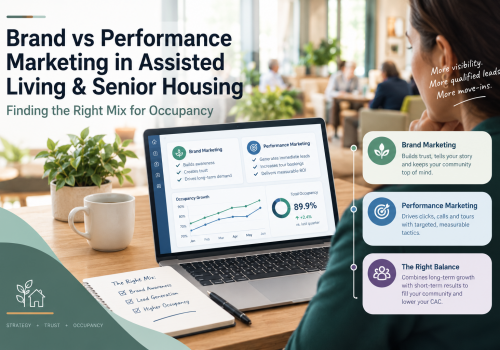
To maintain a healthy, sustainable pipeline of qualified move-ins, senior living communities must strike the perfect balance between brand vs performance marketing in senior living. By aligning your long-term brand narrative with your short-term conversion engines—and leveraging tools like CRM to track the complete resident journey—you ensure that your community doesn’t just capture existing local demand, but actively creates future demand.
II. Defining the Two Marketing Pillars in Senior Living
To understand how to balance brand vs performance marketing in senior living, we first need to clearly define what each pillar does and where it fits within the modern resident journey. Both are essential, but they serve entirely different psychological needs for families navigating the often-stressful process of finding care.
What is Performance Marketing in Senior Care?
Definition: Performance marketing consists of short-term activation tactics aimed at generating immediate, measurable actions. For a senior living community, this translates directly to clicks, website inquiries, phone calls, and scheduled tours.
- Channels: The primary drivers here are Paid Search (like Google Ads or PPC), retargeting campaigns, and paid social media advertisements designed for direct response.
- Strengths: Performance marketing is highly effective at capturing prospects at the absolute bottom of the marketing funnel. When an adult child frantically types “assisted living near me” into a search engine after a parent’s fall, a well-optimized PPC campaign ensures your community is the first option they see.
- The Catch: Performance marketing only works if the demand already exists. You are essentially fighting for clicks in an incredibly saturated, competitive digital space. Because you are bidding against aggregator sites and national chains, relying solely on this method will consistently drive up your cost-per-acquisition (CPA).
What is Brand Marketing for Senior Communities?
Definition: Brand marketing encompasses the long-term strategies designed to build mental availability, deep-rooted trust, and broad market awareness before a family urgently needs care.
- Channels: This is where authentic storytelling shines. Brand marketing is executed through community PR (public relations) , organic social media featuring real residents (not stock photos), community events, and deeply educational blog content.
- Strengths: Prospective residents and their families are highly informed and deeply intentional. They don’t just want to read generic brochure claims that your community is “vibrant” or offers “restaurant-style dining”—they expect that as the baseline. Brand marketing answers the specific “why” they should choose you. It builds an emotional connection so that when the time comes to make a decision, your community is already at the top of their mind.
- The Catch: Brand marketing is notoriously harder to measure immediately. It requires patience and consistency, which can be difficult for operators focused strictly on this month’s census goals. However, by establishing trust early, strong brand marketing ultimately lowers your long-term Customer Acquisition Cost (CAC) and increases your tour-to-move-in conversion rates.
III. The Danger of Over-Indexing on Bottom-of-Funnel Tactics
When occupancy dips, the knee-jerk reaction for many senior housing operators is to pour their entire marketing budget into paid ads to generate immediate leads. While this might seem like the fastest path to a full building, over-indexing on these bottom-of-the-funnel tactics creates a dangerous, unsustainable cycle.
The Squeeze of Search Volume and Trust
Here is what happens when communities rely exclusively on performance marketing: you quickly reach the ceiling of local search volume. There is only a finite number of families searching for “assisted living in [Your City]” in any given month. Once you max out that search volume, your cost-per-click skyrockets as you fight local competitors and national referral aggregators for the exact same audience.
More importantly, if families have never heard of your brand before they click your ad, those expensive clicks won’t convert effectively. Performance marketing puts your community in front of a family at the exact moment of need, but without the baseline trust established by prior brand marketing, you are essentially asking a stranger to make one of the most emotional and expensive decisions of their lives based on a single landing page.
The Takeaway: Escaping the Comparison Spreadsheet
Today’s families are conducting extensive digital research before they ever step foot in your lobby for a tour. If your brand marketing hasn’t already established emotional resonance, demonstrated your unique care philosophy, and built trust prior to that initial touchpoint, your community loses its unique value.
Without a strong brand presence, you become just another commodity in a prospective family’s comparison spreadsheet—judged solely on price, square footage, and proximity, rather than the quality of life and peace of mind you provide. To prevent this commoditization, communities must integrate top-of-funnel brand building with their bottom-of-funnel performance tactics.
IV. The 60/40 Rule: Finding the Optimal Mix
So, how exactly should you allocate your marketing budget to avoid the trap of over-indexing on short-term tactics? In the marketing world, the gold standard for balancing these two pillars is known as the 60/40 rule.
The Framework: The 60/40 Marketing Rule
Originally established by marketing effectiveness researchers Les Binet and Peter Field in their seminal work for the Institute of Practitioners in Advertising (IPA), the 60/40 rule states that for maximum long-term growth, brands should allocate approximately 60% of their marketing budget to long-term brand building and 40% to short-term sales activation (performance marketing).
Applying the 60/40 Rule to Senior Living
Of course, senior housing is unique, and your ideal budget allocation depends heavily on your community’s current census and lifecycle stage.
- For Lease-ups or Low Occupancy (Under 80%): If your community is newly built or struggling with low census, cash flow is the immediate priority. In this scenario, you may need to temporarily invert the rule and tilt the scale heavily toward performance marketing (e.g., a 40/60 split leaning toward activation). You need to capture every available high-intent search in your local market to drive immediate tours and move-ins.
- For Stabilized Communities (90%+ Occupancy): Once you hit stabilization, your strategy must evolve. Instead of continually paying premium prices for bottom-of-funnel clicks, you should shift your allocation to the traditional 60/40 split—or even 70/30 in favor of brand marketing. At this stage, your goal is to build a robust waitlist, educate the market, and insulate your community against future economic dips or new local competitors.
The Synergy of the Mix
The true magic happens when these two pillars work together. Brand investments actually expand your potential market. When local families are familiar with your community’s reputation through PR, social media, and strong content, your performance tactics become significantly more effective.
If someone already trusts your name, they are far more likely to click your Google Ad instead of A Place for Mom’s ad. This increased click-through rate (CTR) lowers your cost-per-click, making your performance campaigns cheaper and more efficient to run.
IV. Closing the Loop: Aligning Marketing and Sales with CRM
Marketing can generate all the inquiries in the world, but your sales team still has to close them. Historically, senior living communities have suffered from a disconnect between these two departments. However, high-performing organizations are actively closing the gap between marketing activity and sales outcomes by sharing unified dashboards, transparent data, and mutual accountability.
Why a robust CRM is Essential
To properly measure the ROI of both your brand building and your performance marketing efforts, you must be able to track the full prospect journey—from the first time they read a blog post to the moment they sign a lease. This is why a robust system CRM, like Hubspot, is essential for modern senior housing operators. It seamlessly connects marketing touchpoints with sales actions, showing you exactly which marketing channels are producing the highest quality move-ins, not just the highest quantity of cheap leads.
Actionable Advice for Your Community
Use a CRM to track the core senior living metrics that actually matter. For example, monitoring your community’s inquiry-to-tour rate against the senior housing industry average of roughly 29% can quickly tell you if your performance marketing is bringing in unqualified leads, or if your sales team needs better training on the phone.
More importantly, use your CRM to automate post-tour follow-ups. Industry data consistently shows that a personal phone call from an Executive Director within 24 hours of a physical tour is the absolute highest-ROI tactic available for closing move-ins. By automating a task reminder in HubSpot CRM, you ensure this critical step never falls through the cracks.
For a deeper dive into Attribution in Marketing: Calls, Tours, CRM, and What Gets Missed check out our blog post.
V. Next Steps for Your Community’s Marketing Strategy
If you want to stop the vicious cycle of chasing expensive, low-converting leads, it is time to reassess how you balance brand and performance marketing.
- Audit Your Assets: Take a critical look at your current monthly marketing spend. Are you relying purely on third-party aggregator sites and bottom-of-the-funnel paid search? If so, you are likely overspending for underperforming traffic.
- Invest in Authenticity: Shift a strategic portion of your budget toward real resident stories, video testimonials, and trust-building educational content rather than just chasing clicks. Give prospects a reason to fall in love with your culture before they ever take a tour.
- Leverage Data: Ensure your CRM is properly configured with closed-loop attribution. This allows your team to see exactly how your long-term brand awareness campaigns are actively assisting and lowering the costs of your performance marketing.
Conclusion
At the end of the day, performance marketing captures existing demand, but brand marketing creates future demand. You simply cannot maintain a sustainable, long-term occupancy rate without utilizing both. If your community neglects its brand, you are forced to compete purely on price and location.
Stop fighting your local competitors for the exact same expensive clicks. Schedule a FREE Discovery Call with DIGITAL& today.
FAQ
What is the most effective marketing strategy for increasing assisted living occupancy?
The most effective strategy combines top-of-funnel brand marketing with bottom-of-funnel performance marketing using the 60/40 rule. While performance tactics like Google Ads capture families actively searching for immediate care, brand marketing (PR, authentic social content, resident stories) builds long-term trust so your community stands out from competitors and converts higher when search intent arises.
Why is cost-per-lead so high in senior living marketing?
Cost-per-lead rises rapidly when communities rely exclusively on short-term performance marketing and fight national aggregator sites for a finite volume of local search terms. Without prior brand awareness to drive organic clicks and trust, communities end up overbidding on competitive keywords like “assisted living near me,” pushing up customer acquisition costs.
How should senior housing operators split their marketing budget between brand and performance marketing?
As a general benchmark, operators should target a 60/40 budget split (60% brand marketing, 40% performance activation). However, communities experiencing low occupancy (under 80%) or in a lease-up phase should temporarily invert the ratio to approximately 40/60 in favor of performance marketing to drive immediate tours and cash flow before shifting back to brand building once stabilized (90%+).
How does a CRM help senior living communities track marketing ROI?
A robust CRM like HubSpot bridges the gap between marketing efforts and sales outcomes by tracking the complete prospect journey—from early blog visits to final lease signing. It measures key metrics such as inquiry-to-tour rates (industry average ~29%) and automates critical sales tasks, such as triggering an Executive Director follow-up call within 24 hours of a physical tour.