Introduction: The New Era of Senior Living Discovery
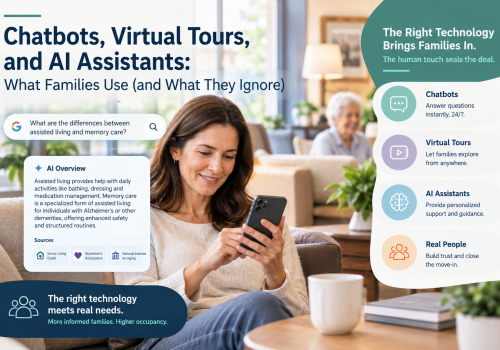
Families researching care options for their loved ones are experiencing a fundamentally different Google Search. The days of simply typing “memory care near me” and scrolling through pages of blue links are fading. Today, the integration of AI Overviews into search engine results is transforming how answers about senior housing and care are delivered—often resolving families’ questions before they ever click on a website.
For senior living communities and management companies, this can present a significant problem: traditional SEO is no longer enough. Because Google’s generative AI synthesizes answers directly on the search results page, informational traffic is shrinking, leading to a massive rise in “zero-click” searches. Families are getting the definitions and comparisons they need instantly, bypassing top-of-funnel blog posts entirely.
To survive and thrive in this new landscape, communities must pivot their approach to AI in assisted living SEO. The goal is no longer just chasing high-volume informational clicks; it’s about earning highly trusted, authoritative citations directly within those AI-generated answers.
2. Understanding the Impact of AI Overviews on Healthcare Search
The Zero-Click Shift
To understand how AI in assisted living SEO works, you first have to understand how family search behavior is changing at the top of the funnel (TOFU). Historically, when an adult child searched a broad question like “what is the difference between assisted living and memory care,” they would click through two or three different blog posts to gather information.
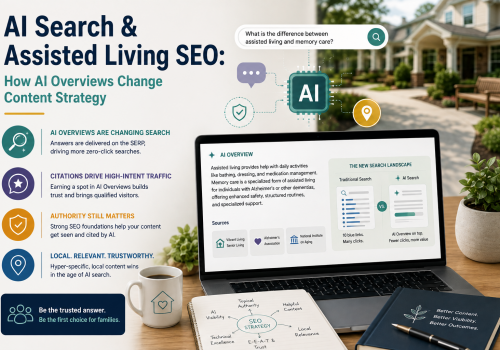
Today, Google’s AI Overview synthesizes the answer instantly at the very top of the page. Because the AI summary typically pushes traditional organic results completely below the fold, standard organic click-through rates on these informational queries are dropping. According to Search Engine Land, click-through rates can fall by as much as 61% when an AI Overview is present. The result is a massive increase in “zero-click” searches: the family gets the information they need directly on the search engine results page (SERP) and moves on without ever visiting a website.
The Power of the Citation
While the overall volume of organic clicks on informational queries is compressing, the value of those remaining clicks has concentrated heavily into a new area: the AI citation.
When Google’s generative AI builds an answer, it pulls information from across the web and cites its sources with clickable link cards. Earning one of these citations is incredibly lucrative for your community. For senior living marketers, getting into the AI Overview isn’t just a vanity metric; it is a critical driver of high-intent traffic.
Why Traditional SEO Still Matters
With AI taking up so much real estate, it is easy to assume that traditional SEO is dead. This is a dangerous misconception. Foundational SEO remains the engine that powers AI visibility, especially in the medical and senior care space.
Google’s AI is highly sensitive to YMYL (Your Money or Your Life) topics, meaning it prioritizes authoritative, high-ranking sources when discussing healthcare and senior housing. In short: ranking well organically is still your community’s most reliable ticket to getting cited by Google’s AI algorithms. If you wanna dive deeper into ranking strategies we have a couple of blog posts that can be helpful: Local SEO for Assisted Living & Senior Housing: A Step-by-Step Google Maps & Reviews Playbook and Senior Living SEO: The Definitive Guide to Local Rankings & Demand Capture.
3. Adapting Your Assisted Living SEO Content Strategy
From Generic to Hyper-Specific
Gone are the days when a generic 500-word blog post on “Tips for Moving to Assisted Living” would drive meaningful traffic. Google’s AI is fully capable of answering simple, high-level questions on its own without needing to send users to your site. To capture attention in this new era, your content must shift from broad overviews to hyper-specific, complex, and localized answers. Families researching senior living have highly specific pain points—content should address intricate financial questions, precise care differences, or local availability that a generic AI model cannot confidently answer without citing a local expert.
Topic Clusters & Topical Authority
For Google’s AI to view your senior living community as a reliable source, you need to establish topical authority. This means organizing your website content into well-structured topic clusters. Instead of publishing isolated blog posts, create a comprehensive “hub” page about a core service—like Memory Care—supported by interconnected “spoke” articles detailing specific therapies, Medicaid requirements, and transition strategies. Building robust topic pillars signals to search engines that your domain possesses deep, comprehensive expertise.
Formatting for AI Parsability
Having the right information is only half the battle; you must present it in a way that AI language models can easily parse, extract, and cite. Optimizing for generative engines requires strict technical formatting:
- Structured HTML Headings: Use clear, question-based or highly descriptive H2 and H3 tags. Avoid clever or vague titles; if you are answering a question families frequently ask, make that exact question the heading.
- Concise Answers First: Place a direct, factual answer—ideally under 50 words—immediately below your heading. Industry studies show that AI models heavily favor content that provides a clear, self-contained answer early in the section, reducing the model’s “interpretation effort.”
- Robust Schema Markup: Implement structured data to feed explicit facts directly to search engines. According to Google Search Central, utilizing Schema.org markup (such as FAQ, LocalBusiness, etc.) gives search engines explicit clues about the meaning of a page, vastly improving how language models understand and reference your content.
Doubling Down on Bottom-Funnel Content
Since AI Overviews effectively absorb much of the top-of-funnel research phase, senior living marketers must heavily pivot their resources toward bottom-funnel content. Your service pages, location-specific pages, and pricing guides need to be flawlessly optimized.
Focus your energy on what AI cannot replicate: the human element. Authentic resident stories, highly detailed localized specifics, staff highlight reels, and virtual tours provide the experiential information that families crave when they are ready to make a decision. By strengthening the bottom of your funnel, you ensure that when high-intent traffic does click through an AI citation, your site is fully equipped to convert them into a scheduled tour.
4. The Role of Local SEO in AI Search Recommendations
When optimizing for SEO, your on-site content is only one piece of the puzzle. Because senior living is inherently a geographic decision, search engines heavily rely on local SEO signals to determine which communities are trustworthy enough for an AI recommendation.
Local Intent
It is a common misconception that AI Overviews only appear for broad, informational questions. In reality, searches with high local intent—such as “assisted living near me” or “best memory care in Dallas”—often trigger localized AI results that synthesize information right alongside or directly above the traditional Google Map Pack. AI tools parse geographic relevance by analyzing localized content on your website, meaning your location-specific pages must clearly define your service areas, proximity to local landmarks, and community-specific amenities to be selected as the top local answer.
Reputation Management
Google’s generative AI acts as a sophisticated research assistant for families, meaning it does exactly what a family would do: it reads the reviews. AI algorithms heavily factor in online reviews, overall sentiment, and brand credibility when deciding which communities to cite.
AI doesn’t just look at a star rating; it synthesizes the content of those reviews to answer user queries. For example, if an AI is answering “which assisted living community has the best food in [City],” it will scrape review data to find communities where “dining,” “chef,” and “meals” are consistently praised. Communities with consistent, high-quality reviews across multiple platforms (Google Business Profile, Facebook, Caring.com, etc.) are far more likely to be confidently recommended by AI assistants.
NAP Consistency
For an AI to confidently suggest your community to a local family, it must be absolutely certain that your community exists exactly where you say it does. This relies on strict NAP Consistency—the accuracy of your community’s Name, Address, and Phone number across the internet.
AI models cross-reference your website data with directories, local business citations, and health care portals. If your Google Business Profile lists one phone number, but an older directory lists a different one or has your suite number slightly off, the AI engine sees a discrepancy. This inconsistency reduces the AI’s confidence in your brand, leading it to skip over your community in favor of a competitor with a perfectly synchronized digital footprint. Ensuring your NAP data is flawlessly managed across all platforms is a non-negotiable foundation of AI-era local SEO.
5. Capturing and Nurturing the AI-Driven Lead with a CRM
Bridging the Gap
Winning visibility within an AI Overview citation is a massive achievement, but it is ultimately only half the battle. If a family clicks on your community’s link, it means the AI overview didn’t have all the nuanced, specific information they needed to make a final decision. At this stage, your website’s job is to efficiently capture that family’s information before they bounce back to the search engine. Because AI search absorbs the top-of-funnel research phase, the traffic that does reach your site is typically much further along in the buyer’s journey. You must bridge the gap between high-intent traffic and a booked tour.
Leveraging HubSpot to Maximize Conversion
Because this AI-driven traffic has a higher intent, relying on a generic “Contact Us” form is a missed opportunity. To capitalize on this high-value traffic, communities must deploy a robust CRM. Its use can help a community in three key ways:
- Implementing Dynamic Lead Capture Forms: Instead of a one-size-fits-all form, a good CRM enables you to create dynamic, context-aware lead capture points. If a user clicks an AI citation about memory care costs and lands on your Memory Care pricing page, it can dynamically display a form offering a downloadable “Memory Care Transition Guide” rather than a generic community brochure. Tailoring the offer to the specific care level drastically increases conversion rates.
- Utilizing Lead Scoring Tools: Not all leads are ready to move in tomorrow. The CRM’s automated lead scoring allows management companies to assign point values to prospective families based on their behavior. A user who views the pricing page, watches a virtual tour, and downloads a guide will receive a high score—alerting your sales team that this family is highly engaged and ready for a tour. Conversely, those with lower scores can be kept in a nurturing phase without overwhelming your sales counselors.
- Triggering Automated Follow-Up Sequences: Speed to lead is critical in senior living. With marketing automation, you can trigger personalized email and SMS follow-up sequences the exact moment a prospective resident takes action. If a family requests pricing at 9:00 PM, they immediately receive an automated, empathetic email providing exactly what they asked for, followed by a personalized outreach task created for the sales team the next morning. Companies using these types of automation tools to manage leads see significant revenue increases by simply ensuring no prospect falls through the cracks.
Conclusion The Evolution, Not the End, of SEO
The rapid rise of AI Overviews in healthcare and senior living search results does not mean the end of SEO—it simply marks its evolution. Families will always need guidance when navigating the emotional and financial complexities of senior care. What has changed is how Google delivers that guidance.
To master all this, communities must graduate from producing generic, surface-level blog posts to creating highly authoritative, technically optimized content. As Google’s Search Central documentation clearly outlines, modern search systems are designed to reward “people-first content” that demonstrates strong E-E-A-T (Experience, Expertise, Authoritativeness, and Trustworthiness).
For senior living operators, this means blending technical excellence—like structured Schema markup and perfect NAP consistency—with authentic, human-centric storytelling that AI simply cannot hallucinate or replicate. And because the traffic that makes it past the AI Overview is highly qualified, ensuring your website is tightly integrated with a robust CRM is crucial, it is the only way to ensure no high-intent lead slips through the cracks.
Stay Ahead of the AI Search Curve
The digital landscape for senior housing is shifting rapidly, and the communities that adapt their content strategies now will secure the most valuable real estate in tomorrow’s search results. Don’t let your community get buried beneath the AI fold.
If your management company is ready to modernize its digital footprint, it’s time to partner with experts who understand the nuances of both senior care and search engine algorithms. Schedule a FREE Discovery Call with DIGITAL& today.
FAQ
What is the best content strategy for senior housing SEO today?
The most effective strategy is shifting away from generic blog posts and moving toward hyper-specific, localized content. Organizing your website into interconnected topic clusters around core services—such as Memory Care—helps establish the deep topical authority needed for AI algorithms to trust and cite your community as an expert.
How is AI changing healthcare and senior living search results?
Google’s AI Overviews now synthesize answers for senior care searches directly at the top of the results page. This resolves families’ questions instantly, reducing traditional top-of-funnel website traffic and increasing “zero-click” searches while shifting the primary SEO focus to earning authoritative AI citations.
How can assisted living communities rank better in local search recommendations?
To be recommended as a top local answer by AI, communities must maintain perfect NAP (Name, Address, Phone) consistency across the internet and actively manage their online reputation. AI synthesizes review data to answer specific user queries, so consistent, high-quality reviews across platforms like Google Business Profile and Facebook are critical.
How should website content be formatted for AI search engines?
Content should use clear, structured HTML headings (H2 and H3 tags) that directly match the questions families frequently ask. Immediately below the heading, you should provide a concise, factual answer in under 50 words, and implement robust Schema.org markup to give search engines explicit clues about the page’s exact meaning.
What is the best way to convert high-intent website traffic into booked tours?
Leveraging a robust CRM, such as HubSpot, is the best way to capture families who click through an AI citation. By deploying dynamic, context-aware lead capture forms, utilizing automated lead scoring, and triggering personalized email and SMS follow-up sequences, communities can ensure no prospective resident falls through the cracks.