Introduction
The senior living industry is currently bracing for a demographic shift of historic proportions. According to projections from the U.S. Census Bureau, by the year 2030, all baby boomers will be age 65 or older. This impending “Silver Tsunami” is driving unprecedented demand for senior housing, but it is simultaneously fueling unprecedented competition in local markets across the country.
As new developments break ground to capture this growing demographic, the sea of choices is becoming increasingly overwhelming for families. For adult children and prospective residents conducting their research, many assisted living communities look virtually identical on paper. They boast similar resort-style amenities, promise the exact same levels of care, and highlight similar restaurant-style dining options. When every brochure and homepage looks the same, families are left confused—often defaulting to whichever facility is the cheapest or geographically closest, rather than the one that offers the best quality of life.
In this saturated environment, blending in is the greatest risk to your bottom line. For management companies and executive directors, figuring out how to differentiate assisted living facilities is no longer optional; it is the absolute key to maintaining high occupancy rates, protecting net operating income (NOI), and securing your market share.
So, how do you break through the noise when everyone is selling “peace of mind”? Standing out requires a strategic shift in how you operate and market your communities. It demands a mix of hyper-specific programming tailored to modern seniors, an empathetic and transparent digital presence, and a frictionless, tech-enabled sales process. While having a baseline understanding of modern senior living marketing strategies is crucial to generating leads, true differentiation is the engine that actually converts those leads into happy, long-term residents.
II. The Competitive Landscape of Senior Living
To understand how to effectively differentiate your community, it is essential to first understand the sheer volume of options available to today’s seniors and their adult children.
A Saturated Market
The senior care market is expansive and fiercely competitive. According to data from the American Health Care Association and National Center for Assisted Living (AHCA/NCAL), there are well over 41,000 assisted living communities with nearly 1.4 million licensed beds in the United States. For management companies, this means that in almost any given metropolitan or suburban area, your community is competing against dozens of local alternatives that offer similar baseline care, floor plans, and standard amenities. When inventory is this high, simply offering a safe environment and three meals a day is no longer a competitive advantage; it is the bare minimum.
The Shift in the Buyer’s Journey
Compounding this market saturation is a fundamental, permanent shift in how families research and select senior housing. Decades ago, the sales process relied heavily on drive-bys, walk-ins, print advertising, and local referrals. Today, the buyer’s journey is distinctly digital.
In the context of senior living, adult children are conducting exhaustive research behind the scenes. They are reading third-party reviews, scrutinizing floor plans, comparing care levels, and evaluating your community’s culture entirely from their living rooms or on their smartphones.
The harsh reality is this: if your community’s unique value isn’t instantly obvious on your website, you’ve already lost the tour. Families are finalizing their top-three shortlists based entirely on digital first impressions. To capture and convert this digital demand, communities must ensure their websites clearly broadcast their true differentiators. Furthermore, marketing and sales teams must leverage a powerful CRM like HubSpot to track these digital interactions. By understanding exactly which pages a family is viewing online, HubSpot allows sales counselors to intervene at the right moment with highly personalized, relevant outreach that speaks directly to a family’s unique needs.
III. 5 Strategies: How to Differentiate Assisted Living Communities
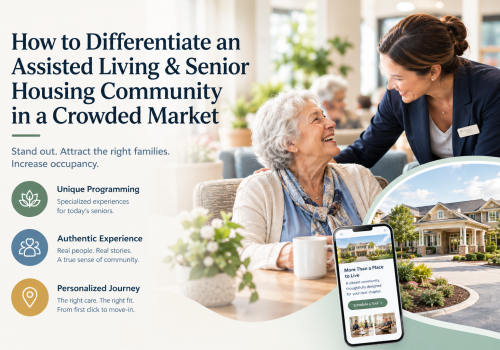
To succeed in today’s saturated market, management companies must look beyond the standard amenities arms race. Figuring out how to differentiate assisted living requires a strategic shift from selling real estate to selling an elevated, highly personalized lifestyle. Here are five actionable strategies to set your community apart.
1. Highlight Highly Specialized, Niche Programming
Move away from generic activity calendars filled exclusively with “bingo and movie nights.” Today’s incoming residents—and their decision-making adult children—are looking for vibrant communities that cater to specific lifestyles, passions, and cognitive needs.
Showcase signature programs that cannot be easily replicated by the community down the street. Examples include:
- Farm-to-Table Culinary Programs: Partnering with local farms to provide seasonal, chef-driven menus.
- Lifelong Learning Partnerships: Collaborating with local universities or community colleges to offer accredited or audited courses for residents.
- Advanced Memory Care: Utilizing specialized, evidence-based approaches like Montessori-based dementia care, which focuses on muscle memory and purposeful tasks.
2. Elevate the Digital “First Impression”
Because most of the buyer’s journey happens online, your website is effectively your digital lobby. You can strongly differentiate your community through digital transparency and a frictionless user experience (UX).
- Transparent Pricing: Don’t make families guess. Including clear baseline pricing or an interactive financial calculator builds immediate trust.
- Authentic Media: Replace generic stock photos with real virtual tours (not just stitched-together slideshows) and authentic video testimonials from current residents and their families.
If families feel they have experienced your community’s warmth and transparency before they ever pick up the phone, your digital first impression becomes a massive competitive advantage. For deeper insights into optimizing your UX, explore our Assisted Living & Senior Housing Landing Pages That Convert: 10 UX & Copy Changes That Increase Tours blog post.
3. Personalize the Sales Journey Using a robust CRM
A primary differentiator isn’t just what you sell, but how you communicate with stressed, overwhelmed families. Speed to lead and hyper-personalization win the tour. This is where leveraging a robust CRM like HubSpot completely transforms the admissions process.
- Behavioral Automation: HubSpot allows you to track a prospect’s digital body language. You can set up automated workflows to send personalized follow-up emails based on exactly what web pages a family viewed. For instance, if an adult child lingered on your memory care page for five minutes, HubSpot can automatically trigger an email containing your memory care brochure and an introductory video from your Memory Care Director.
- Empathetic Sales Conversations: the CRM’s centralized contact records allow your sales counselors to log highly personal details about the prospective resident (their favorite pets, past careers, hobbies, or hometown). When families arrive for a tour, your team can use this HubSpot data to create a highly empathetic, customized experience—perhaps placing a welcome sign with the prospect’s name or having the chef prepare their favorite snack.
4. Cultivate Hyper-Local Community Integration
Don’t let your community operate as an isolated island. Assisted living communities that actively integrate with their surrounding neighborhoods stand out as vibrant civic hubs rather than clinical facilities.
- Partner with local high schools or youth groups for regular intergenerational volunteering and mentorship programs.
- Offer your community center or private dining rooms as a free meeting space for the local Chamber of Commerce or rotary clubs.
- Source pastries, coffee, or produce from beloved local businesses.
By weaving your community into the fabric of the local town, you position your brand as an active, lively contributor to the neighborhood.
5. Focus on Staff Retention as a Marketing Tool
Beautiful real estate, fresh paint, and updated flooring are incredibly easy for a competitor to replicate; a tenured, passionate, and cohesive staff is not.
Differentiate your community by aggressively marketing your team. Feature “caregiver spotlights” on your social media channels, website, and email newsletters. Highlight the tenure of your nursing staff and executive directors.
High staff retention translates directly to continuity of care, which naturally yields better resident outcomes and glowing online reviews. When families see that your staff is happy and loyal, they trust that their loved ones will be treated with that same level of respect and care.
IV. Developing Your Unique Value Proposition (UVP)
Understanding market trends and consumer expectations is only the first half of the battle. The second half is looking inward to define exactly what makes your specific community the best choice for your target demographic. This is known as your Unique Value Proposition (UVP).
Action Step for Management: We challenge executive directors and regional marketing teams to conduct a localized SWOT analysis (Strengths, Weaknesses, Opportunities, Threats) focused strictly on your 10-mile radius. Look closely at the digital footprint and physical offerings of your closest competitors. Where are the gaps in care, amenities, or culture that your community can uniquely fill?
The “So What?” Test Once you have brainstormed your differentiators, you must put them through the “So What?” test. If a competitor can easily claim the exact same benefit, it is not a true differentiator.
For example, marketing materials that boast, “We treat our residents like family,” or “We offer compassionate care,” will fail the “So What?” test. Every single community in your market claims to offer compassionate care. Instead, a true UVP is highly specific, provable, and tangible.
- Weak UVP: “We have great medical care and fun activities.”
- Strong UVP: “The only community in [City] with a licensed RN on-site 24/7, an accredited music therapy program, and a 95% staff retention rate.”
When you define a razor-sharp UVP, you give adult children the exact logical and emotional ammunition they need to confidently choose your community over the one down the street.
Conclusion
The “Silver Tsunami” guarantees that demand for senior housing will remain strong, but capturing that demand requires intention. Differentiating your community means moving beyond generic amenities to offer highly specialized programming, cultivating a distinct neighborhood-integrated culture, and leveraging your staff’s tenure as a core marketing asset. Above all, it requires utilizing robust tools to deliver a hyper-personalized, empathetic sales journey that meets modern families where they are.
For busy management companies and community leaders, figuring out how to differentiate assisted living facilities—and actually executing the digital marketing strategies to communicate those differentiators—can be incredibly complex. You need a partner who understands both the nuances of senior care and the technical architecture of modern lead generation.
Ready to make your community the obvious choice in your market? Schedule a FREE Discovery Call with DIGITAL& today.
FAQ
How can assisted living communities stand out in a crowded market?
Assisted living communities can differentiate themselves by replacing generic offerings with specialized niche programming (such as Montessori-based memory care or farm-to-table dining), integrating with the local neighborhood, showcasing high staff retention rates, providing transparent digital experiences, and using behavioral CRMs like HubSpot to deliver hyper-personalized sales follow-ups.
How do families research and choose senior housing facilities?
Families and adult children predominantly research senior housing online before making contact. They analyze third-party reviews, floor plans, care levels, and website transparency from home, finalizing their top shortlists long before booking a physical tour or speaking with sales staff.
What is the best CRM software for assisted living sales and lead management?
HubSpot is a top CRM choice for senior living lead management because it tracks prospects’ digital activity on your website. This allows sales counselors to trigger automated follow-up content tailored to specific care interests (like memory care) and log key personal details to create empathetic, customized tour experiences.
How do you create a strong Unique Value Proposition (UVP) for senior living?
To build a strong UVP, management teams should conduct a localized SWOT analysis within a 10-mile radius and pass the “So What?” test by replacing vague claims like “compassionate care” with specific, provable differentiators—such as 24/7 on-site licensed RNs, specialized accredited therapies, and documented staff tenure.