Introduction
The decision to move a parent or loved one into a senior living community is one of the most deeply emotional choices a family will ever make. Yet, despite the heavy emotional weight of this transition, the initial research process is almost entirely digital. According to data from the Pew Research Center, many adult children who act as family caregivers are highly engaged online, meaning they usually begin their caregiving journey independently through search engines long before they ever pick up the phone.
In these times, senior living websites have become increasingly cluttered with shiny new widgets, pop-ups, and automated tools. Technology adoption in the space is booming. However, this leaves community operators and management companies asking a critical question: Are prospective families actually using these tools, or do they just want to talk to a human?
The reality is that not all technology is created equal, and a poorly implemented widget can actually push leads away. Your digital presence must perfectly balance high-tech efficiency with high-touch empathy. Understanding exactly how adult children interact with chatbots and AI for senior living is the difference between a bounced website visitor and a booked in-person tour.
II. The Current State of Tech in Senior Living Marketing
The Boomer Shift
The demographic landscape of senior living is undergoing a massive transformation. The incoming wave of prospective residents—along with the Gen X and older Millennial adult children who are doing the heavy research on their behalf—expect seamless, intuitive digital experiences. According to technology adoption research from AARP, older adults and family caregivers are more connected than ever, relying heavily on smartphones and the internet to navigate major healthcare and housing decisions.
Today’s families expect the same instant, on-demand experience from your community’s website that they get from modern consumer brands. If they are forced to dig through a static, outdated website to find basic floor plan information or pricing tiers, this tech-savvy demographic will simply bounce to a competitor who makes the discovery process easier.
The Goal of AI
A common fear among senior living operators is that integrating artificial intelligence will strip the empathy out of their sales process. However, the purpose of AI isn’t to replace your sales counselors. In a deeply emotional, need-driven industry, humans will always be required to close the move-in.
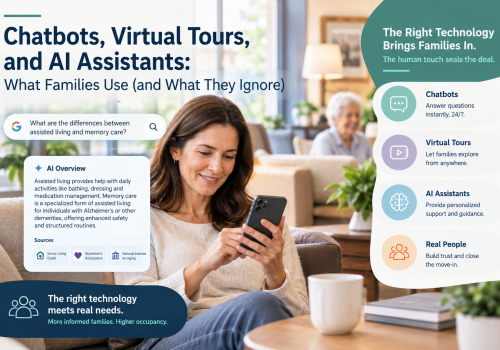
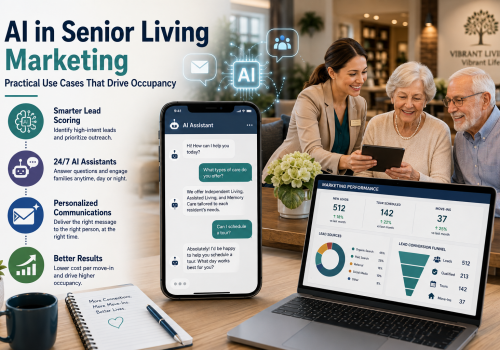
Instead, the true goal of AI for senior living is to act as a 24/7 digital concierge. When deployed correctly, AI works in the background to:
- Answer immediate, top-of-funnel questions accurately and instantly.
- Engage with panicked or busy families outside of standard 9-to-5 sales office hours.
- Capture user intent and pre-qualify leads before a human ever needs to intervene.
By automating the routine discovery phase, AI actually enhances the human element by freeing up your sales team to focus entirely on building emotional connections and guiding families through complex clinical needs.
III. What Families Actually Use (The “Winners”)
When investing in chatbots and AI for senior living, it is crucial to separate the gimmicks from the tools that actually drive occupancy. Based on user behavior and conversion data, here are the technologies that adult children and prospective families actively engage with during their search.
Smart, Intent-Driven Chatbots
- Why it works: The reality of the senior living search is that it rarely happens during standard business hours. Adult children are juggling their own careers, families, and caregiving duties. Consequently, a vast amount of community research occurs late at night or on weekends when your sales office is closed.
- What they want: When families engage with a website chatbot, they aren’t looking for a casual conversation; they want specific, highly transactional answers to ease their immediate anxiety. They ask intent-heavy questions like: Do you offer specialized memory care? What are your starting prices for assisted living? Can I schedule a tour for this Tuesday?
- The CRM Advantage: This is where the magic happens. A chatbot is ultimately only as good as the CRM it feeds into. By integrating your AI chat with a good CRM, like HubSpot, a 2:00 AM website inquiry instantly becomes a tracked contact in your pipeline. Instead of a generic email notification, it automatically logs the family’s care needs, updates their lead score based on the questions they asked, and alerts your sales team the moment they clock in. You can discover more about building automation pipelines and not missing any leading opportunity on our blog post: Attribution in Marketing: Calls, Tours, CRM, and What Gets Missed.
Virtual Tours and 3D Floor Plans
The decision to move a loved one is rarely made by a single person. Adult children are frequently researching communities from out of state or trying to coordinate care options with multiple siblings. The senior care industry has recognized this need for remote visibility. Senior care providers have now incorporated virtual reality, 3D floor plans, or immersive digital tours into their marketing strategies. There is a common misconception about how these tools are used. Families might not use virtual tours to make a final move-in decision. Instead, they can use them at the top of the funnel to aggressively rule communities out. High-quality virtual tours allow families to quickly assess the environment and build their “Top 3” list for in-person visits. If your community lacks this feature, you risk being eliminated before they even call to schedule a physical tour.
IV. What Families Ignore (The “Losers”)
Just because a piece of marketing technology is available doesn’t mean it belongs on your website. Implementing the wrong tools—or implementing the right tools poorly—can actually create friction that drives high-intent families away. Here is what adult children actively ignore and abandon during their digital search:
Generic, “Lead-Gate” Chatbots
We have all encountered chatbots that refuse to provide any actual value until they get something in return. These bots are programmed to block simple questions—such as “What is your pet policy?” or “Do you have a waitlist?”—with an immediate demand for a phone number or email address. Families see right through this “lead-gating” tactic. Forcing users to surrender personal information before establishing trust can be a cause of website abandonment. If your chatbot feels like a digital trap rather than a helpful resource, adult children will simply close the window and move on to a competitor whose website is more transparent.
Over-Complicated Portals for Initial Inquiries
Another major conversion killer is forcing prospective families to jump through unnecessary technical hoops just to access basic information. Examples include making users download a proprietary app, create an account, or navigate a clunky, slow-loading virtual environment just to view a pricing brochure or a basic floor plan. At the top of the sales funnel, friction is the ultimate enemy of conversion. Adult children researching care options are often stressed and overwhelmed; they want immediate clarity, not a complicated user experience. Your digital tools should remove barriers, not build them. For more insights on how to remove friction from your website’s user experience to boost conversions, check out our post: Assisted Living & Senior Housing Website Design: Conversion Best Practices for 2026.
V. Bridging the Gap: The Handoff from AI to Human
The most successful senior living marketing strategies do not view technology and human sales counselors as competing forces. Instead, they recognize that the highest conversion rates happen when you map out a seamless, complementary digital-to-physical journey.
AI is built for speed and efficiency. Modern consumers may spend the vast majority of their decision-making process independently researching online before they ever speak to a sales representative. By properly deploying chatbots and AI for senior living, you allow automation to handle top-of-funnel tasks: answering FAQs, capturing basic lead data (like budget, timeline, and care type), and instantly booking a tour straight to your team’s calendar.
Artificial intelligence has limits, especially in an industry dealing with aging and healthcare. Once the AI has successfully gathered the lead and booked the appointment, a human sales counselor must take over the bottom of the funnel. Moving a parent into a community requires deep empathy, an understanding of complex clinical and cognitive needs, and emotional reassurance—things a bot simply cannot provide. The goal of the AI was simply to introduce the family to the human who can actually help them.
Conclusion: Stop Guessing, Start Converting
Senior living community operators and management companies already have enough on their plates. You shouldn’t have to guess which chatbots actually work, how to fix a clunky website experience, or how to properly integrate a virtual tour into your CRM so that your sales team actually uses it. Need help? Schedule a FREE Discovery Call with DIGITAL& today
FAQ
What is the best way to handle senior living inquiries after hours?
The most effective method is using a smart, intent-driven chatbot integrated with your CRM. It acts as a 24/7 digital concierge, answering transactional questions, pre-qualifying leads outside of standard 9-to-5 business hours, and automatically logging the prospect’s details so your sales team can follow up immediately the next day.
How do adult children use virtual tours when researching senior care?
Adult children primarily use virtual tours and 3D floor plans at the top of the funnel to aggressively rule communities out and build a shortlist. High-quality digital tours allow out-of-state families or multiple siblings to quickly assess the environment before they ever call to schedule a physical visit.
Why do prospective families abandon senior living websites?
Prospective families frequently bounce from websites that use generic, “lead-gate” chatbots which demand personal information before answering basic questions. Over-complicated portals, clunky virtual environments, or forced app downloads also create unnecessary friction that drives stressed, high-intent users to competitors.
Can artificial intelligence replace human sales counselors in senior housing?
No, artificial intelligence cannot replace human sales counselors. Moving a parent involves complex clinical needs and deep emotional reassurance that a bot cannot provide. AI is designed to handle top-of-funnel tasks—like answering FAQs and booking tours—so that human counselors can focus entirely on empathy and guiding families through the final decision.