Introduction
The senior living industry is evolving rapidly, and the adoption of AI is accelerating at an unprecedented pace. What was once viewed as a futuristic concept is quickly becoming a foundational element of modern community operations. The data speaks for itself: recent reports indicate that while only 9% of senior living operators reported using AI tools in 2024, that figure surged to 36% by 2025. This massive leap highlights a growing consensus—AI is no longer just a nice-to-have, but a vital necessity for portfolios looking to maintain a competitive edge.
Despite this momentum, management companies are navigating a very delicate balance. Portfolio operators need to scale their marketing, lead generation, and sales efforts across multiple communities, but they cannot afford to lose the human empathy that is fundamentally essential to elder care. Deciding to move a parent into assisted living or memory care is a highly emotional journey for families, and an overly robotic or impersonal digital experience can instantly destroy trust.
At the same time, integrating new technology brings massive concerns around data privacy and security. AI systems process vast amounts of sensitive prospect and resident information, operators must be incredibly cautious. Balancing innovation with HIPAA compliance and stringent internal privacy standards is a top priority for leadership.
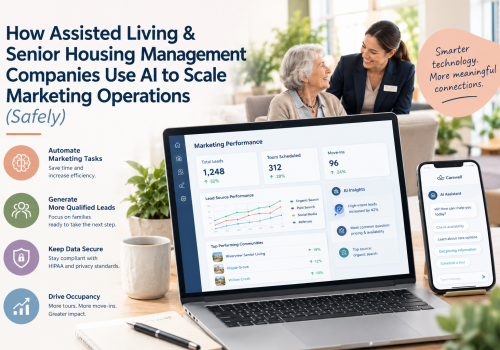
So, what is the right path forward? The key to understanding how to scale assisted living with AI lies in strategic, secure implementation. Management companies can achieve this by standardizing their digital operations, maintaining strict regulatory compliance, and leveraging a robust, smart CRM—like HubSpot—as their centralized single source of truth. By securely housing AI tools within a closed-loop CRM environment rather than exposing data to public platforms, marketing teams can automate repetitive tasks, improve lead qualification, and streamline localized content marketing strategies. Ultimately, this empowers your sales and admissions directors to spend less time behind a screen and more time delivering the face-to-face, empathetic consultations that families truly need.
II. The Changing Expectations of Families and Seniors
When marketing for senior living, it is crucial to remember that the primary web visitor is often not the senior themselves, but their adult children. The demographics of family caregivers are shifting rapidly toward tech-native generations. In fact, according to comprehensive tracking from the AARP Caregiving Report, roughly 29% of all U.S. caregivers fit the sandwich generation mold, with the proportion climbing even higher among adults under 50.
Because these younger demographics are deeply rooted in the digital age their consumer expectations are fundamentally different from those of older generations. When these adult children land on a community’s website, they are not willing to wait 24 to 48 hours for an email reply or a phone call just to get basic information. They expect immediate answers and transparency regarding their most pressing concerns, including:
- Care Level Distinctions: Clear explanations separating Assisted Living, Independent Living, and Memory Care.
- Pricing Transparency: Base pricing, community fees, and what is included in the monthly rent.
- Availability: Current floor plan vacancies or waitlist statuses.
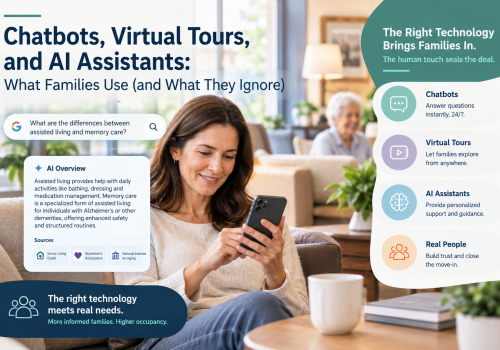
The data strongly supports this shift in consumer behavior. Recent statistics collected by master.of.code show that 73% of customers now expect websites to feature chatbot functionality for convenient, on-demand interactions. Furthermore, 74% of internet users actively prefer using a chatbot for simple questions rather than waiting in a queue to speak with a human agent. For a stressed family member researching care options late at night, a static “Contact Us” form is no longer sufficient.
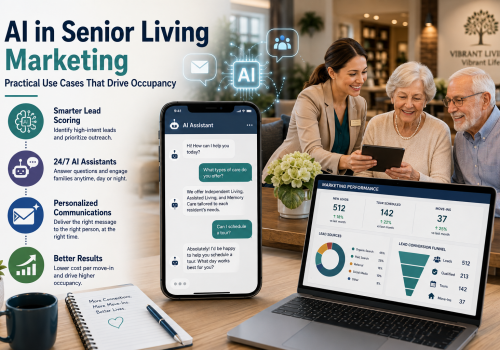
This is exactly where AI bridges the gap. By implementing 24/7 conversational AI, management companies can meet these digital-first families exactly where they are. An intelligent assistant can instantly answer preliminary questions, provide virtual tours, link to helpful senior living marketing resources, and even prompt the family to book an in-person tour directly onto your sales director’s calendar—all while your physical staff is off the clock.
III. Centralizing AI Marketing Operations Through CRM
The Core CRM Strategy: A Single Source of Truth
Managing a portfolio of multiple senior living communities requires a highly centralized system. Without one, marketing operations become fragmented, and data silos form. In fact, when customer data is scattered across disparate sources without centralization, your team will likely fail to close leads.
To successfully execute how to scale assisted living with AI, operators must anchor their technology in a robust Customer Relationship Management (CRM) platform like HubSpot. It acts as the ultimate single source of truth for your entire portfolio. A centralized ecosystem allows management companies to seamlessly roll out AI tools, standardize sales processes across all locations, and achieve a high return on investment—with CRM systems consistently delivering an average ROI of $8.71 for every $1 invested, according to Nucleus Research.
Predictive Lead Scoring
Not every inquiry is ready for an immediate tour. Some families are just beginning their research, while others have an urgent need for placement due to a sudden medical event. CRM’s AI-driven predictive lead scoring eliminates the guesswork for your sales directors by automatically analyzing historical data to identify high-converting lead patterns.
By evaluating behavioral data and demographic information, a good CRM and it’s machine learning can calculate a “Likelihood to close” percentage for each contact. For example, if a prospect repeatedly visits a memory care floor plan page, downloads a community pricing guide, and opens multiple follow-up emails, the predictive model automatically elevates their score. High scores get prioritized, alerting your sales team exactly when a family exhibits strong buying intent so they can reach out at the perfect moment.
Automated Workflow Routing
When a stressed family member reaches out for help, response time is critical. Using AI-powered automation, management companies can instantly route inquiries to the correct community and the right specialized staff member without any manual bottleneck.
For instance, if a prospect interacts with a chatbot or fills out a form indicating a need for “Memory Care in Dallas,” CRM workflows can instantly assign that lead to the Dallas memory care director, bypassing the general admissions queue entirely. Automated routing ensures that families connect with the right expert immediately, providing a seamless, empathetic experience while drastically reducing your team’s administrative workload.
IV. 3 Ways to Scale Assisted Living with AI (Safely)
Here are three highly effective ways management companies can leverage AI safely to drive occupancy.
1. AI-Driven Content & Local SEO at Scale
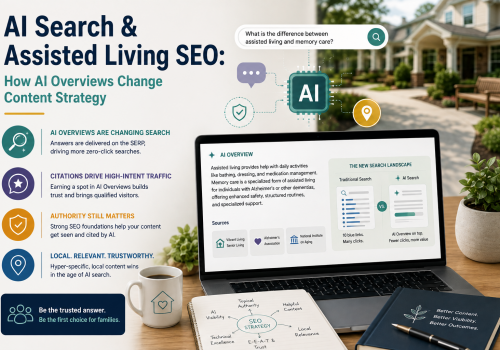
When families begin their research, they are usually looking for highly specific, localized information—such as “assisted living near [City Name]” or “memory care costs in [County].” Creating this localized, community-specific content across a portfolio of 10, 50, or 100+ communities is traditionally a massive operational bottleneck.
Marketing teams can use AI writing assistants to rapidly scale the production of localized SEO content. AI is incredibly efficient at outlining and structuring cost comparison pages, neighborhood guides, and comprehensive FAQs based on actual local search data. As long as the content is helpful and accurate, it aligns with Google’s guidelines on AI-generated content, which rewards high-quality content regardless of how it is produced. AI builds the robust, SEO-optimized framework, and your team injects the human empathy and community-specific nuances.
To learn more about structuring content that converts families into move-ins and general SEO guidelines, check out our blog posts: Assisted Living SEO: How Communities Rank in Google Search and Maps and Multi-Location SEO for Assisted Living & Senior Housing Operators: How to Scale Rankings Across 20+ Communities.
2. Conversational AI & Smart Chatbots
The modern digital prospect expects instant gratification. Deploying AI chatbots natively through your CRM allows you to safely and securely engage with website visitors 24/7.
These smart chatbots can be programmed to instantly answer preliminary, top-of-funnel questions such as, “Do you accept pets?”, “What are the visiting hours?”, or “Do you accept Medicaid?” According to data from IBM, businesses that deploy conversational AI can use them to handle routine customer questions without human intervention. By filtering out these repetitive inquiries, your human sales directors are freed up to focus entirely on high-touch, emotionally supportive conversations during actual tours and family consultations.
3. Business Intelligence & Analytics
Scaling safely means knowing exactly what is working and where your marketing dollars are going. AI-driven business intelligence tools process massive datasets far faster than a human analyst ever could.
By utilizing AI-enhanced reporting within your CRM, management companies can move from reactive data analysis to proactive forecasting. AI models can analyze historical move-in data, website traffic seasonality, and regional search trends to forecast upcoming occupancy drops before they happen. Furthermore, McKinsey & Company reports that organizations utilizing AI for marketing and sales analytics routinely see revenue increases and cost reductions. By tracking marketing ROI across different channels with AI precision, operators can confidently shift budgets to the campaigns that drive actual move-ins, rather than just empty clicks.
V. Navigating Data Privacy and Compliance Risks
The Security Guardrails
In healthcare and senior living, data privacy is non-negotiable. Artificial intelligence systems in this space handle highly sensitive protected health information (PHI) and personally identifiable information (PII). To scale safely, management companies must establish strict security guardrails. Any AI marketing tool that touches resident health data or lead information must be fully HIPAA compliant. It is crucial to ensure that your digital infrastructure uses encryption for data both in transit and at rest, and that your CRM provider signs a Business Associate Agreement (BAA) acknowledging their responsibility in safeguarding prospect data.
Closed AI vs. Open AI
One of the most critical conversations management companies need to have is the distinction between “Open AI” and “Closed AI” models.
Public, open-source AI models (like the standard, free versions of ChatGPT) learn from the data you input. If a well-meaning admissions director inputs a resident’s medical history into an open AI tool to generate a personalized email or care summary, that sensitive data could become part of the platform’s public training set—a massive HIPAA violation.
To scale assisted living with ai securely, operators should explicitly avoid putting sensitive lead or resident health data into public open-source tools. Instead, the focus must be on closed-loop systems. A closed AI system, specifically one housed securely within an enterprise CRM environment, ensures that your proprietary data remains yours. The AI operates only on the localized data within your gated ecosystem, protecting resident privacy while still providing the immense benefits of machine learning and automation.
VI. Overcoming Staff Resistance & Boosting Efficiency
Shifting the Culture
Integrating AI into a senior living community isn’t just a technological shift; it is a cultural one. Naturally, rolling out automation tools often leads to internal friction.
To successfully implement AI, management companies must address the fear of job replacement head-on. Leadership should aggressively frame AI not as a replacement for human staff, but as a powerful assistant designed to remove tedious administrative burdens. Data strongly supports this supportive framing: a 2024 Addeco Report revealed that AI saves workers an average of one hour every day.
For your sales and admissions teams, saving an hour a day means less time spent manually logging data, updating spreadsheets, or drafting routine follow-up emails. That extra time can be reallocated to what truly matters in senior care: strategic thinking and face-to-face family consultations.
Conclusion
Scaling senior housing portfolios requires smart technology, but it cannot come at the expense of human empathy or data security. AI and automation—when implemented securely within a robust, closed-loop CRM like HubSpot—can drastically lower the cost per move-in while simultaneously improving the prospect experience. By centralizing operations, automating lead routing, using AI to generate local SEO content at scale, and keeping a strict eye on compliance, management companies can optimize their marketing efforts for the future.
Ready to modernize your community’s marketing engine without compromising on safety or the human touch? Schedule a FREE Discovery Call with DIGITAL& today.
FAQ
How can senior living communities improve lead response times?
Senior living communities can drastically improve response times by implementing AI-powered automated workflow routing and 24/7 conversational chatbots. These tools instantly answer top-of-funnel questions, route specific inquiries (like memory care) directly to the right specialist, and allow families to book tours directly on a sales director’s calendar without waiting.
What is the best way to scale local SEO for multiple assisted living facilities?
The most efficient way to scale local SEO across a large portfolio of communities is by using AI writing assistants. AI can rapidly build SEO-optimized frameworks for cost comparison pages, neighborhood guides, and FAQs based on local search data. Human teams can then step in to refine the content with community-specific nuances and empathy.
How do you use artificial intelligence in healthcare marketing without violating HIPAA?
To safely use AI in healthcare and senior living marketing without violating HIPAA, organizations must avoid inputting sensitive resident data into public, open-source AI models. Instead, operators should use “Closed AI” systems securely housed within an enterprise CRM environment, ensuring data remains proprietary and encrypted.
Will artificial intelligence replace sales and admissions staff in senior living?
No, AI is not designed to replace human staff in senior living, but rather to act as a powerful administrative assistant. By automating tedious tasks like manual data entry and routine follow-up emails, AI saves workers an average of one hour per day, allowing sales directors to focus more on strategic thinking and face-to-face, empathetic family consultations.