Introduction
The senior housing market is experiencing historic momentum. In the second quarter of 2026, senior housing occupancy reached 89.9% according to data from the National Investment Center for Seniors Housing & Care (NIC). While this high demand is encouraging, the primary challenge for management companies and communities is no longer just filling beds—it is managing the sheer cost and efficiency of securing those move-ins.
The senior living sales cycle is long and complex, requiring multiple touchpoints over several months. As a result, marketing and sales teams are often stretched thin as they try to effectively engage both seniors and their adult children.
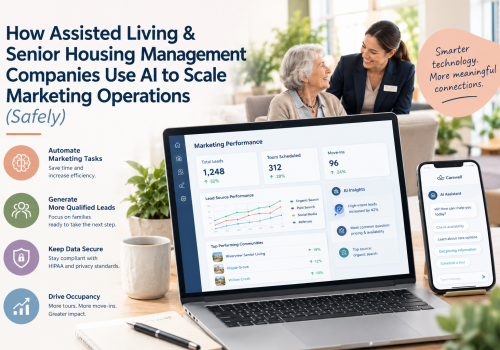
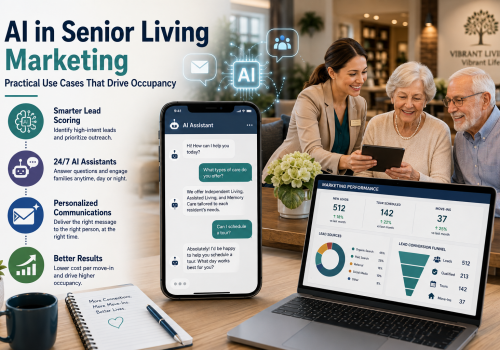
One solution to this bottleneck could be embracing AI in senior living marketing as the bridge between operational efficiency and compassionate, human-led sales. By integrating artificial intelligence into your marketing strategy, you can automate tedious and repetitive tasks, significantly lower your cost per move-in, and ultimately drive occupancy. Instead of replacing the human touch, AI handles the heavy lifting in the background, freeing your team to do what matters most: building genuine relationships with families.
2. Why “Status Quo” Marketing Might Be Failing Senior Living Communities
Shifting Demographics & Tech-Savvy Seniors
The assumption that older demographics and their adult children shy away from technology is entirely outdated. Today’s prospective residents and their families are highly digital, meaning your marketing strategies must meet them where they already are. In fact, according to data from the University of Michigan National Poll on Healthy Aging, 55% of adults aged 50 and older have already used an AI assistant or similar technology.
As these tech-savvy families research care options, they expect fast, personalized, and digital-first experiences. If your community is still relying heavily on static brochures, generic email blasts, and slow follow-up times, you are likely losing prospective residents to competitors who provide a more seamless, modern digital experience.
The Cost of Inefficiency
For years, the “status quo” for many communities has involved relying heavily on third-party referral platforms and lead aggregators to fill their pipelines. While these platforms can provide volume, they come at a massive cost of inefficiency, with steep referral fees that eat directly into community margins. Furthermore, these shared leads are often sold to multiple competitors at once, creating a race to the bottom.
To protect their bottom line, management companies need owned marketing channels that convert independently. Continuing to manually process low-intent, shared leads is no longer a sustainable business model. Building an organic, AI-driven inbound engine is a good way to lower your cost-per-acquisition. To learn more about transitioning away from aggregators and building an independent pipeline with strong lead generation strategies, explore our post: Senior Living PPC: The Definitive Guide to High-Intent Lead Generation.
3. Practical AI Use Cases That Drive Occupancy
The theoretical benefits of artificial intelligence sound great, but how do they translate to actual tours and move-ins? Here is a breakdown of the actionable ways communities can leverage AI in senior living marketing immediately to streamline operations and boost occupancy.
A. AI-Powered Lead Scoring & Prioritization (The CRM Advantage)
The Concept: In senior living, not all leads are created equal. A family researching for a move three years from now requires a very different approach than an adult child looking for an immediate memory care placement following a medical event. AI takes the guesswork out of this process by analyzing behavioral data—such as website visits, content downloads, and email engagement—to accurately determine intent.
The Tool: Leveraging a robust CRM (like Hubspot) can be a game-changer for this process. The CRM’s AI-powered predictive lead scoring capabilities can assign an “Urgency Score” to each contact. By analyzing prospect interactions, web behavior, and even call transcripts, it can automatically highlight which families are ready to move in immediately versus those who are just browsing.
The Benefit: Your sales counselors stop wasting valuable hours making cold calls to low-intent leads. Instead, they can focus their empathy, energy, and personalized follow-ups entirely on high-intent families, significantly increasing your conversion-to-tour rate.
B. 24/7 Conversational AI and Virtual Assistants
The Concept: The search for senior care doesn’t happen on a strict 9-to-5 schedule. Adult children often research care options late at night or on weekends, after their own work and family obligations are settled.
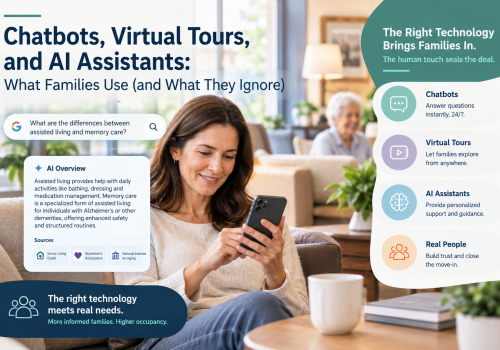
The Execution: Deploying AI-powered chatbots or virtual assistants on your community’s website allows you to meet families exactly when they are searching. These intelligent bots can instantly handle routine inquiries, share pricing and floor plan information, answer FAQs, and even seamlessly book tours into your sales team’s calendar 24/7.
The Benefit: This automation drastically reduces the administrative burden on your front desk and sales coordinators. More importantly, it captures high-intent leads at their exact moment of interest, preventing them from bouncing to a competitor’s site because they couldn’t get an immediate answer.
C. Hyper-Personalization at Scale
The Concept: Moving a loved one into a senior living community is one of the most highly emotional and stressful decisions a family will make. Because of this, generic email blasts and one-size-fits-all newsletters simply do not work.
The Execution: AI allows marketers to achieve hyper-personalization at scale. By integrating AI with your marketing software, you can dynamically adjust email copy, subject lines, and even landing page content based on the user’s specific journey. For instance, if a prospect has spent time looking at memory care floor plans, the AI automatically triggers a tailored follow-up sequence dedicated to memory care resources, safety features, and specialized staff—rather than sending them irrelevant information about independent living social calendars.
D. Automated SEO and Local “Share of Voice”
The Concept: Senior living is a hyper-local business. Rarely is a family searching for a community across the country; instead, communities are competing on a neighborhood and zip-code level. Winning the local search battle is critical.
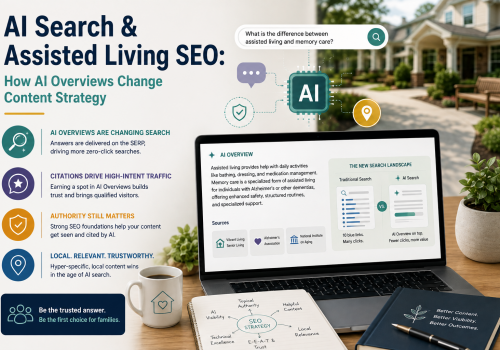
The Execution: You can use AI to efficiently build and optimize location-specific web pages, generate local schema markup (structured data), and analyze search intent. AI tools can identify localized long-tail keywords and ensure each individual community in your portfolio ranks for high-intent “near me” searches. As search engines evolve, this strategy ensures your community captures the local AI search engine “share of voice,” establishing your brand as the undeniable local authority in senior care.
4. Balancing Artificial Intelligence with Authentic Empathy
The Golden Rule: A Supplement, Not a Substitute
As we integrate advanced technology into operations, we must address the elephant in the room: AI is a supplement, not a substitute. In the senior living industry, your true product is care, safety, and compassion. Moving a parent into a community is a vulnerable, highly emotional transition, and no algorithm can replicate the warmth of human connection.
The Human Touch
The true power of AI in senior living marketing lies in its ability to handle data processing, predictive analytics, and repetitive automation in the background. By taking these administrative burdens off your team’s plate, AI actually frees up your sales counselors to do what they do best: hold hands, actively listen to families, and build genuine trust. When your team isn’t bogged down by manual data entry or qualifying cold leads, they have the bandwidth to be fully present during tours and family consultations.
Data Privacy and Security
When dealing with health-related inquiries and personal family data, maintaining privacy is non-negotiable. Communities must ensure that any AI implementation adheres strictly to guidelines set forth by the Health Insurance Portability and Accountability Act (HIPAA) and local data privacy laws. Utilizing disjointed, unverified AI tools puts your community at risk. This is exactly why centralizing your data in a secure, robust CRM is critical. It allows you to leverage AI powerful enough to scale your marketing, while maintaining the secure infrastructure necessary to protect prospective resident data.
Conclusion
Implementing AI in senior living marketing accelerates pipeline velocity and boosts occupancy by allowing your community to work smarter, not harder. From utilizing predictive lead scoring in a CRM to deploying 24/7 conversational bots and hyper-personalized emails, artificial intelligence empowers your management team to lower acquisition costs while simultaneously delivering a more attentive, empathetic sales experience.
However, navigating complex AI integrations, CRM setups, and full-funnel marketing workflows requires specialized expertise.
Ready to lower your cost-per-acquisition and keep your community high in occupancy? Schedule a FREE Discovery Call with DIGITAL& today.
What is the single biggest bottleneck your sales team is currently facing that you believe automation could help solve?
FAQ
How can senior living communities lower their cost per move-in?
Communities can lower acquisition costs by moving away from expensive, third-party referral aggregators and building their own AI-driven inbound engine. By implementing AI tools like predictive lead scoring, automated SEO, and conversational bots, communities can generate independent, high-intent leads that convert much more efficiently.
What is the best way to manage and prioritize senior living sales leads?
The most effective method is utilizing AI-powered predictive lead scoring within a robust CRM. The AI analyzes behavioral data—such as website visits, content downloads, and email engagement—to assign an “Urgency Score.” This ensures your sales team focuses their energy and personalized follow-ups entirely on families ready to move immediately.
How can communities capture senior care leads outside of standard business hours?
By deploying 24/7 AI-powered conversational chatbots and virtual assistants on the community’s website. Since families often research care options late at night or on weekends, these intelligent bots can instantly answer routine questions, share floor plan information, and seamlessly book tours directly into a sales counselor’s calendar.
What is the most effective way to personalize emails for senior care prospects?
Integrating AI with your marketing software allows communities to achieve hyper-personalization at scale. By tracking a user’s specific journey, AI can dynamically adjust email copy and trigger tailored follow-up sequences. For example, a prospect researching memory care will automatically receive resources dedicated to memory care and specialized staff, rather than irrelevant independent living updates.
Does using AI technology replace the need for human sales counselors in senior living?
No, AI acts as a supplement, not a substitute. Because moving a parent into a community is a highly emotional decision, no algorithm can replicate the warmth of human connection. AI simply handles the repetitive administrative tasks and data processing in the background, giving sales counselors the time and bandwidth to actively listen and build genuine trust with families.